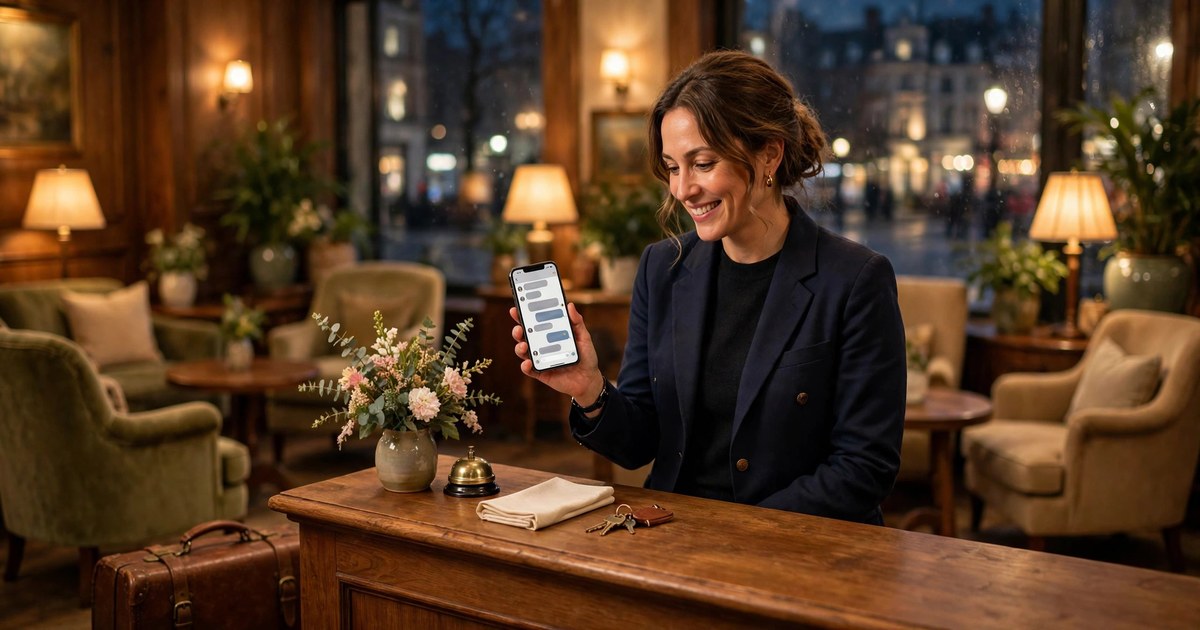
The Linden is a 38-room boutique hotel off Euston Road in London, with a small front desk and a spa with two treatment rooms behind the lounge. On a wet Tuesday in November, the night porter, Daniel, is on his own. The phone rings, a WhatsApp message lands, and the website chat pings, all within ten minutes. A guest landing at Heathrow asks if she can still check in at midnight, her train into Paddington delayed. A couple in room 12 want a spa slot for Saturday morning. A guest who checked out that morning left a charger in room 7 and is already on a train to Manchester. Daniel can only answer one person at a time, and the midnight guest will not wait until morning. She will book somewhere else, or through a booking site that takes a cut.
That Tuesday is the normal shape of a hotel evening. Guests ask questions when they are travelling, which means late at night, early in the morning, and on Sundays, when the front desk is at its thinnest. This article follows those real hotel moments. You will see which guest questions a chatbot should answer first, how it turns a chat into a room sold on your own website, and how to set one up so it sounds like your hotel, not like a call centre.
An AI chatbot for hotels is a friendly online helper that answers guest questions day and night, shows live room prices and availability, takes direct bookings on the hotel website, and handles check-in, spa and breakfast requests, so guests get answers in seconds and the hotel keeps more bookings instead of paying a booking site for them.
Why hotel messages pile up after the front desk quiets down
A hotel never really closes, but its front desk does get quiet. After nine in the evening, the day team goes home and one person is left holding the desk, the phone, and the door. That one person cannot be in three chats at once: a cot for a baby, whether the bar is still open, whether the lift fits a wheelchair. When the answer is slow, the guest does not blame the rota. She just books the place that answered.
The problem is sharper for hotels than for shops, because a hotel guest is often mid-journey when she writes: standing in an airport, sitting on a train, walking down a street with a suitcase. She has a phone in one hand and a decision to make in the next minute. She needs to know if the room is free, what it costs, and whether she can get in late. If the hotel's chat says nothing for an hour, that guest has already moved on to the next listing.
Small hotels feel this most. A big chain has a central reservations team working through the night. A 30-room hotel in Bloomsbury does not. Its duty manager is doing the night shift, the breakfast setup, and the lost-property drawer all at once. A chatbot does not replace that person. It covers the questions with a clear, honest answer while the duty manager welcomes the late arrival, carries a case upstairs, or calms a guest whose flight was cancelled.
Guesthouses face the same evening rush in a smaller house, as shown in the WhatsApp automation for guesthouses article, where one owner and a phone carry the whole evening.
What guests actually ask before they book a room
Guests ask a short list of questions, in the same words again and again. Is a room free this weekend. What does it cost, and does that include breakfast. Is there parking. How far is the station, and how long is the walk with a suitcase. Can I check in early, or late. Is the room quiet. Do you have a family room, or a cot. Is breakfast included, and what time does it start. Can I bring my dog. Each question is fair, and each one is a small test.
Price questions need a careful touch. A guest who sees a room at, say, £140 a night on a booking site will ask why the hotel's own website shows a different number, or whether breakfast is in that price. A chatbot should answer with the hotel's real rates and say plainly what is included: breakfast, taxes, and any extras like parking. It should never guess a rate it has not been given: a guest who arrives expecting one price and finds another remembers the surprise longer than the room.
Distance questions are where a hotel chatbot earns its keep in a way a booking site cannot. A booking site says the hotel is 0.4 miles from the station. A good hotel chatbot says it is a six-minute walk from Euston, flat all the way, and the shortcut through the side street avoids the hill. It says the lift is small, so a guest with heavy cases should ask for a ground-floor room. The quiet rooms face the garden, not the road. Only the hotel itself knows those details. A travel agency chatbot answers a different kind of trip question, as shown in the AI chatbot for travel agencies article, but the hotel's job is the stay itself: the room, the walk, the breakfast, and the night's sleep.
How a late-night question becomes a direct booking
A direct booking is a room sold on the hotel's own website, without a booking site in the middle. It matters because booking sites take a cut of every room they sell, and because a guest who books direct is the hotel's guest from the first message: the hotel has her email, her arrival time, and her preferences. A guest who books through a site arrives as a name on a list.
The moment a direct booking is won or lost is usually small. A guest finds the hotel on a search, opens the website, and asks one question: is a double room free on Friday, and what does it cost with breakfast. If the chat answers in seconds, with a live price and a booking link, the guest can book there and then, on her phone, in the taxi. If the chat says someone will reply tomorrow, the guest goes back to the booking site, where the same room is one tap away. Speed is not a nice extra here. Speed is the whole sale.
The chatbot should make the booking path short: dates, rooms actually free, price with breakfast included or not, and the booking link in the same chat. It should also say the cancellation rule in plain words before the guest pays. A guest who knows she can cancel up to 48 hours before arrival books with more confidence than one who finds the rule in small print after paying. Hotels that want the same direct-booking thinking on the messaging channel can read the WhatsApp automation for restaurants article, where the same short path from question to booking applies to tables instead of rooms.
Check-in, early check-in and the 11 PM arrival
Check-in questions are where hotel chatbots prove themselves or fall apart. Guests do not ask about check-in in theory. They ask because their train is late, their flight landed early, or they are standing outside with a suitcase in the rain. The chatbot needs the hotel's real answers: check-in from 3 PM, check-out by 11 AM, early check-in when the room is ready, and exactly what happens after the desk closes.
The midnight arrival at the Linden is the case to design for. The guest lands at Heathrow, her train to Paddington is delayed, and she messages at 11 PM: can I still check in at midnight, and is there anywhere to eat nearby at that hour. A good chatbot answers both parts: yes, late check-in is fine, here is the door code and the key safe number, and your room is ready; and the kitchen is closed, but the place two doors down serves until 1 AM.
Early check-in needs the same honesty. A guest landing at 7 AM will ask if she can get into her room at 9 AM. The chatbot should not promise a room that is still being cleaned. It should say the room is usually ready from 3 PM, that the hotel will message her the moment it is ready, and that she can leave her bags at the desk and have breakfast while she waits. A guest promised 9 AM who finds a locked door feels misled, and says so in her review.
Many guests message on WhatsApp rather than on the website, so the answer there should match the website word for word, with the door code in the same thread the guest is already reading. How the two channels stay in step is covered in the best WhatsApp automation tools guide, with plain notes on message timing and follow-ups for small businesses. A guest standing outside at midnight does not care which app the hotel uses. She cares that the code she was given opens the door.
The in-stay chatbot: spa, breakfast, extra towels and lost property
See it answer your customers' questions
ReplyPilot builds a website chatbot trained on your services, your prices and your booking rules — it answers in seconds, books the job, and passes tricky conversations to you with the full history attached.
Ask on WhatsApp — it's freeOnce a guest has the key, the questions change, but they do not stop. Can I book a spa treatment for Saturday morning. What time is breakfast. Can I have extra towels. The heating is too warm, how do I turn it down. I left my charger in the room and I am on the train to Manchester, can someone post it to me.
The spa booking is the one worth designing first, because it carries money. A guest at dinner thinks about a Saturday morning massage, messages the chat, and gets an answer while she is still at the table: yes, a 10 AM slot for a 45-minute treatment, at the price on the spa list, booked under her room number. If the chat says someone will reply tomorrow, the guest forgets, or books a spa down the road instead. A hotel spa with two treatment rooms cannot afford to lose a Saturday slot to a slow reply. The chatbot should also state the cancellation notice plainly, so the slot can be offered to someone else instead of sitting empty.
Breakfast questions are simpler, but they shape the review. A guest asks what time breakfast starts, whether it runs to half past ten on Sunday, and whether there is anything gluten-free. The chatbot should answer with the real times and the real menu notes, not a line copied from a brochure. If the kitchen can do gluten-free toast on request, say so. If breakfast ends at ten sharp, say so kindly. A guest who comes down at half past ten expecting breakfast and finds a cleared room blames the hotel, not the chatbot.
Lost property is the quiet test of a hotel's care. The guest who left a charger in room 7 is already on a train to Manchester when she messages. She expects a straight answer: yes, we found it, we can post it to you, here is the postage cost, and here is how you pay for it. A chatbot can take that message, pass it to housekeeping with the room number attached, and say when to expect a reply. It should never promise the item is found before housekeeping has looked. Here a small hotel can beat a big chain: the chain sends a form, the small hotel sends a person to the room, and the chatbot's job is passing the message with the room number intact.
How hotels compare chatbot tools without getting lost
The tool market for hotels is crowded, and every vendor page sounds confident. The steady way through it is to judge tools on your own guests' real messages. Take four of them: the midnight check-in, the spa slot, the lost charger, and the breakfast question. Run each one through every tool you are considering: which one answers in plain words, shows a live room price, books the treatment under the right room number, and knows when to stop and fetch a person. Those four answers tell you more than any feature list.
Some numbers help frame the choice. Banked search data (Semrush via PowerSEOTool, 4 November 2026) puts ai chatbot for hotels at 320 searches a month, keyword difficulty 30 percent, cost per click $0, with a declining trend, so weigh a tool on your own guest messages rather than on hype. A manual search on 6 November 2026 found the first page full of vendor comparisons from Visito, RoomMaster, Lilach Bullock, ChatDirect and Conduit, and not one plain owner guide. That is why testing the four guest questions above matters more than reading another ranking.
Open two of those comparison pages while you test: the Visito hotel chatbots comparison page lays out seven tools for independent hotels, and the RoomMaster hotel chatbots list page ranks ten tools with review scores. Use them as a reading list, not a verdict. Notice which tool each page puts first and whether it explains direct booking, then run your four questions and trust what you see.
The prices named on those pages are worth a look, read carefully. HiJiffy lists public starting prices of $109, $179 and $359 a month, billed yearly, on the Visito page, which checked vendor pages in October 2026. AskSuite documents more than 400 booking-engine integrations on that same page, which matters if your booking engine is the part you cannot change. Conduit lists prices from $18 a unit a month for messaging to $48 a unit a month for the full suite, or a flat $899 a month on its Startup plan. The range is wide. Judge the guest questions first, then weigh the monthly price against the direct bookings it keeps.
One more point shapes how the bot should introduce itself: the European Commission's AI Act page says people should be told when they are talking to a chatbot, so yours should say it is an AI helper at the start, with a person one tap away. A guest who knows that trusts the chat more, not less.
Setting it up so it sounds like your hotel, not a call centre
Setup is mostly writing down what your front desk already says on the phone, in the order it says it. Guests can tell when answers are generic, and when they use your real room names, breakfast times, and words for the walk from the station. The bot should carry your hotel's voice, not a vendor's script.
Start with the first questions your desk hears every week. For most small hotels, they are: is a room free on these dates, what does it cost with breakfast, how far is the station, can I check in early or late, is there parking, do you have a family room, what time is breakfast, and can I book a spa treatment. Teach the bot those questions first, using your own words, then add short answers for the questions that need care: the cancellation rule, the spa cancellation notice, and the lost-property postage step. Each answer should fit on a phone screen.
Then set the limits: questions the chatbot must pass to a person at once are a complaint about a room, a guest who is unwell, a refund request, a bill that does not look right, and any guest who asks for a human. Steps it may offer on its own are a room booking, a spa slot, a breakfast note, a bag-storage note, or a late check-in code. Once both lists are set, the chatbot becomes a steady helper for the front desk. My view is that a hotel chatbot should never sound like a booking site. A booking site sells a room. Your chatbot sells the stay: the quiet room at the back, the breakfast that starts at seven, and the fact that the lift is small, so a guest with heavy cases should ask for the ground floor. Only your hotel knows those things.
What the chatbot must never invent
A hotel chatbot must never invent a room rate, a free date, or a spa time. A bot that guesses a price can book a guest into a rate the hotel cannot honour. A bot that invents a free Saturday can send a family to a full hotel. A bot that promises a spa slot that does not exist can ruin a birthday weekend. When the live system has no answer, the honest reply is that the bot cannot see that date, plus the nearest real alternative and a way to contact a person. Guests forgive a gap. They do not forget being misled.
Rates need a live link to be safe. If the chatbot reads the hotel's real booking engine, it can quote the real price for the real dates; a fixed list typed in weeks ago quotes last month's price to this month's guest. Before launch, test the awkward cases: a fully booked date, a sold-out room type, a spa slot that vanished an hour ago, and a guest who asks for a discount the hotel does not offer. Every test should finish with an accurate note to the guest and a correct record for the desk. A guessed price or a double-booked room means setup is unfinished, however good the chat looks.
Complaints deserve a human, fast. A guest whose room is too cold, whose shower does not work, or whose neighbour is loud at 2 AM does not want a booking link. She wants a person, now. The bot should recognise those cases from plain words and pass them to a person at once, with a warm note and the room number, instead of carrying on with booking steps. Guests accept a bot for booking. They resent one that stands between them and a person when they need one.
A simple rollout plan for a small hotel
Begin with a narrow launch. During week one, cover the top questions only: room availability and price with breakfast, early and late check-in, family rooms, breakfast times, and spa booking. Add a clear direct-booking path with the cancellation rule stated before payment, the late check-in instructions, and the lost-property message path with the room number attached. Then test the flow with staff and a few regulars before you share it widely.
ReplyPilot builds AI chat agents for local businesses that answer customer messages on WhatsApp, Instagram and the web. For a hotel, that helper fits naturally at the booking and front-desk stage, where a guest who has read this article now wants a room of her own. ReplyPilot setup costs $249: a $125 deposit, then $124 at go-live. The Care Plan is $99 a month. Those are the real ReplyPilot prices to weigh against the vendor prices above. To see the booking flow working, take the next step and book a ReplyPilot demo to try a hotel chat with your own questions first.
Frequently asked questions
Can an AI chatbot take a hotel booking without a booking site?
Yes, it can show live room prices and availability on the hotel website and take the booking there. The guest books direct, so the hotel keeps her details and pays no booking-site cut on that room.
Can a chatbot handle late check-in at midnight?
Yes, it can confirm late check-in, share the door code and key safe step, and point the guest to somewhere to eat nearby at that hour. It should only share codes the hotel has set for that guest.
Can a hotel chatbot book spa treatments and breakfast notes?
Yes, it can offer real spa slots from the spa list, book a treatment under the room number, and record breakfast notes such as gluten-free toast on request. It should state the spa cancellation notice clearly.
What happens if a guest leaves something behind?
The chatbot can take the message with the room number and the item, pass it to housekeeping, and tell the guest when to expect a reply. It should never promise the item is found before housekeeping has looked.
Can guests use the hotel chatbot late at night or on a Sunday?
Yes, it can take guest questions and bookings late at night and on Sundays, when many guests are travelling and deciding. Staff pick up the booked rooms and spa slots during hotel hours.
A hotel chatbot earns its place when it answers the late question plainly, books the room on the hotel's own website, and steps aside for a person the moment a guest needs one. The Linden's fictional front desk does not need a louder phone, just a steadier one, open at 11 PM. To see that flow with your own hotel in mind, book a ReplyPilot demo and walk through the hotel demo from first message to booked room.