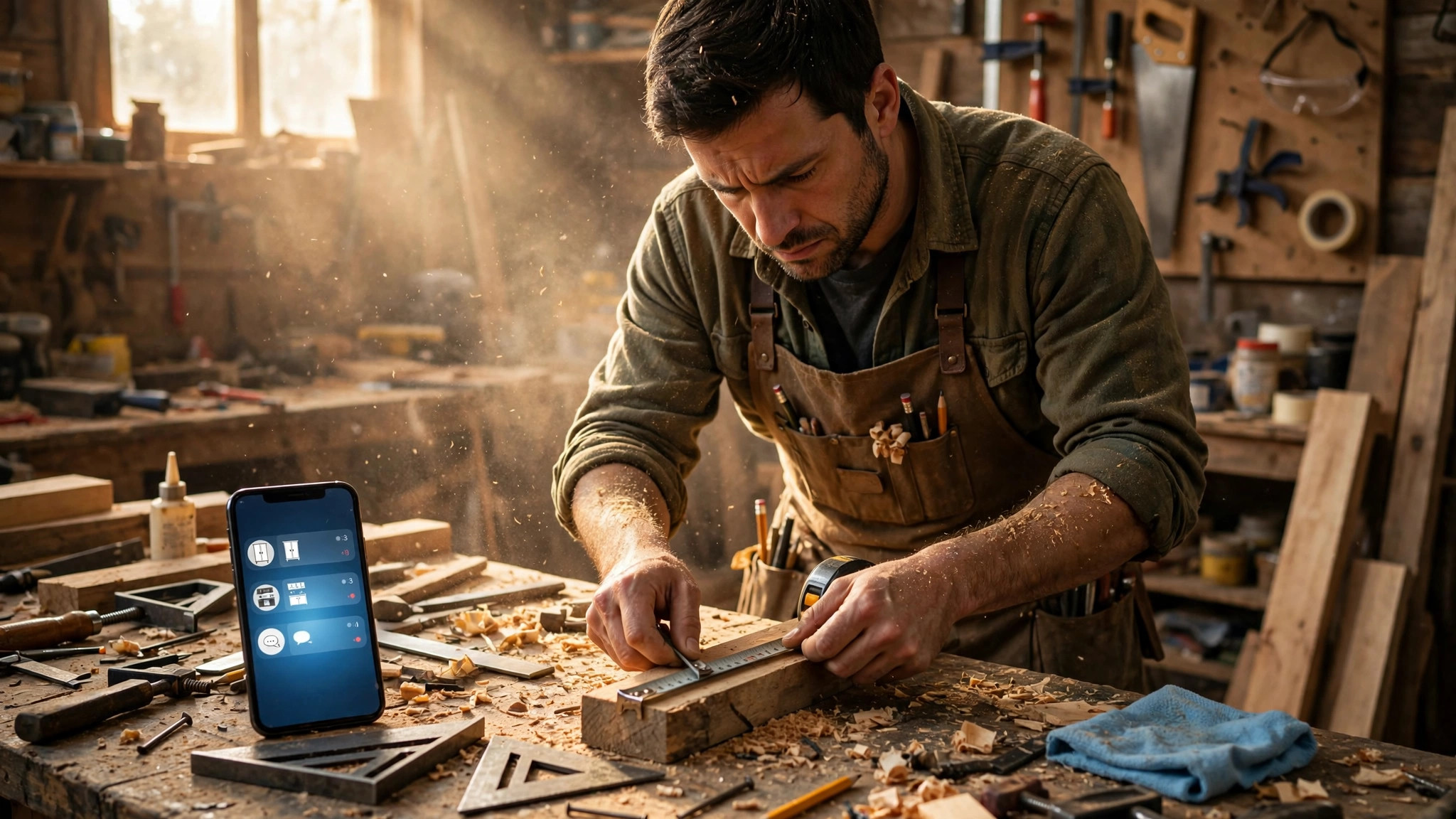
You are on site, halfway through fitting a wardrobe. Your hands are covered in sawdust. Your saw is on the bench, your pencil is behind your ear, and your phone is buzzing in your pocket. Someone wants to know how much fitted wardrobes cost. Someone else has sent photos of a broken door and asks when you can come. A third message just says hello, then asks about a kitchen refit. You cannot stop mid-cut to type long replies. By the time you wipe your hands and check the phone, the moment has passed. The customer has moved on to the next carpenter. This guide fixes that exact problem. It shows how a chat helper on your business WhatsApp number can answer, collect photos and details, and book visits while you keep working. ReplyPilot (AI automation for small-business messaging — WhatsApp, Instagram DM, website chat) is one way to set this up, but the steps here work whatever tool you pick, as long as it follows your rules and hands tricky chats to you.
Quick answer: WhatsApp automation for carpenters is a helper on your business WhatsApp number that answers quote requests in seconds, asks for job photos and measurements, explains your rough process, books site visits from your real diary, and sends reminders and job updates. You set the words and the rules. It handles the routine chats, and hands anything unusual to you.
Below you will find the full owner playbook. It covers why fast replies matter, what the helper should say, how to quote from photos without making promises you cannot keep, how booking and updates work, and the honest limits. Read it once, then set it up around your own jobs.
Why can't carpenter messages wait?
A customer with a broken door or a half-planned kitchen does not message one carpenter and sit patiently by the phone. They message three carpenters at once. They send the same photos three times. They ask the same question three times. Then they pick the one who replies first with a clear next step. That is not rude. That is how people buy trade work when they are busy and a little stressed. WhatsApp automation for carpenters closes that gap. It replies in seconds, even when you are cutting, driving, or measuring a room. The customer feels heard right away. You get a tidy job note instead of a cold lead.
Right now, a carpenter who searches for help with this finds very little made for carpenters. The top results are generic construction lead tools, bulk SMS vendors, and one builder site-report tool. None of them talk about fitted wardrobes, door repairs, skirting boards, or how a carpenter actually quotes from a photo. That gap is your chance. A carpenter-specific setup, written in your own words, will sound more helpful than any generic tool, because it answers the questions your customers really ask.
The carpenter who answers first gets the visit.
What should the automation answer for a carpenter?
Start with the five things customers ask before anything else. First, what kind of job is it. A fitted wardrobe, a door repair, shelves, a kitchen, decking, or a full room refit all need different questions. The helper should ask which one it is, in plain words, and then follow the right path. Second, photos and measurements. Third, your rough process, meaning what happens next. Fourth, a visit booking. Fifth, materials and lead time, answered in your own words.
Materials and lead time deserve care. Customers ask if you supply the timber, if they can pick the finish, and how long the job takes once it starts. The helper should answer only from lines you wrote yourself. If oak doors take longer to order than plain ones, say so in your own words. If you need a deposit before ordering materials, say that too, in a calm and simple way. Never let the helper invent a delivery date or a finish you do not offer. Your words, your rules, every time.
The same idea works across the trades. If you want to see how the same flow looks for other hands-on jobs, read the playbooks for electricians and locksmiths. The jobs change, but the shape stays the same: answer fast, collect the facts, book the visit, and hand over anything odd to a human.
What does a good first reply look like?
A good first reply does three things in a few short lines. It greets the customer warmly, it names the job they asked about, and it asks one clear next question. For example, if someone asks about fitted wardrobes, the reply can say hello, confirm that you build fitted wardrobes, and ask for a photo of the wall plus the width and height. That is it. No long menu of services. No ten questions at once. The customer feels answered, and you get the one fact that moves the job forward.
A weak first reply does the opposite. It dumps every service you offer, asks for an address before the customer trusts you, or says someone will reply later with no time given. Customers read that as a brush-off and move on. Keep the first reply short enough to read at a glance. If the customer answers your one question, ask the next one. A chat that moves one step at a time feels like talking to a helpful person, not filling in a form.
How do you quote from photos without promising the wrong price?
Photos are gold for a carpenter, but only if you ask for the right ones. A single close-up of a broken hinge tells you very little. You need the full door in the frame, a close-up of the damage, and one shot that shows the room around it. For fitted furniture, you need the whole wall, the floor to ceiling height, and any slopes, pipes, or sockets in the way. WhatsApp automation for carpenters asks for these shots step by step, so the customer sends useful photos instead of one dark blurry picture.
Measurements matter just as much. Ask for the width, the height, and the depth, in simple words. Tell the customer to measure twice and send the numbers in the chat. For a door, ask for the door size and the frame size. For shelves, ask for the wall length and how deep they want the shelves. Add one tip that saves a wasted visit: ask the customer to stand back and take one photo of the whole space, so you can spot problems like uneven walls or low ceilings before you drive over.
Here is the rule that protects you. Never promise a final price from a photo alone. A photo hides warped frames, damp patches, and walls that are far from straight. The helper can share the way you work, such as a visit first, then a written quote. It can explain that you set your own quote ranges and that the final figure comes after you see the job in person. That honesty builds trust. Customers respect a carpenter who says plainly what a photo can and cannot tell him.
A photo never sets the final price. The visit does.
How does site-visit booking and reminders work?
Booking a visit should take less than a minute in the chat. The helper offers only slots you really have free, because it reads your diary. The customer picks a day and a time. The helper confirms it back at once, with the date, the time, and what you will look at during the visit. No phone tag. No three missed calls. No note on a scrap of paper that gets lost in the van.
Reminders do the quiet work after that. A message the evening before the visit reminds the customer to be home and to clear the area. A short note on the day says you are on your way. If the customer needs to move the visit, they reply in the same chat and pick a new slot. Fewer wasted trips follow, because people forget less when the plan lives in the chat they already open every day.
A booked visit beats a promised callback every time.
What progress updates should customers get while the job is underway?
Once a job starts, silence worries people. A short update at each stage keeps the customer calm and keeps your phone quiet. When the job starts, send one line that work has begun. If materials are delayed, say so plainly, with the new plan in simple words. When the job is ready for fitting, say when you will arrive and how long fitting should take. Honest wording only. Never promise a finish date you are not sure about.
Your customers are already on WhatsApp
ReplyPilot turns your business WhatsApp into an always-on front desk — instant answers, real bookings in your calendar, and a clean handoff to you the moment a conversation needs a person.
Ask on WhatsApp — it's freeKeep updates short and human. One or two lines beat a long report. Tell the customer what changed, what happens next, and if you need anything from them. If the finish they picked is out of stock, say so and offer the choices you really have. Customers forgive delays far more easily when they hear about them early, in plain words, from you.
Good updates stop worry calls before they start.
How do you turn one job into repeat and referral work?
A finished job is the best time to earn the next one. After fitting, the helper can send a short thank-you note and a simple check-in a few weeks later. Ask if the doors still close well and if the shelves feel right. That small care shows pride in the work. It also surfaces small fixes early, while they are still quick to sort.
Referrals work the same way. When a customer is happy, a short message can ask if a friend or family member needs similar work. Keep it gentle and short. One polite ask beats five pushy ones. The same gentle follow-up idea works for other trades too, as the roofing companies playbook shows, and pest control firms use the same rhythm for repeat visits in the pest control guide.
What about customers who only send hello?
Almost every carpenter knows the one-word message. A stranger sends hello and nothing else. You reply hello back, and then silence. Hours pass. The chat goes cold. The helper fixes this by answering the hello with a warm greeting and one simple choice. It can ask whether the job is a repair, fitted furniture, shelves, or something else, and invite the customer to send a photo. That tiny nudge turns a dead hello into a real enquiry.
If the customer still does not reply, the helper can send one gentle follow-up the next day. Keep it short and kind, along the lines of asking if they still need help with the job. One follow-up is enough. Never send three or four chasing messages, because that feels pushy and can get your number reported. A single polite nudge rescues jobs that shyness or a busy day nearly lost.
What should the automation never try to handle alone?
Some jobs need a human fast, with no chat flow in between. Structural work is one. If a customer talks about removing a wall, a sagging beam, or a floor that feels unsafe, the helper must stop and hand the chat to you at once. Safety-critical jobs are another. Anything involving gas, electrics, or a structure that could fail needs a qualified person, not a chat reply. The helper should say clearly that this needs a human, and pass the full chat to you.
Disputes need a human too. If a customer is unhappy with the finish, the price, or the timing, the helper should not argue, defend, or offer fixes on its own. It should thank them, take down the details, and flag the chat for you right away. A fast human reply saves far more work than a clever automated answer. Write these handover rules down before you switch anything on, and test them like you would test a new saw.
How do you set it up, step by step?
Setup is simpler than most carpenters expect. You do not need new software skills. You need your words, your diary, and a calm afternoon. Work through these steps in order.
- Step 1 — Use a business number. Keep business chats on a WhatsApp Business number, away from your personal chats. Customers should always reach the business, not your family group.
- Step 2 — List your job types. Write down every job you take, from door repairs to fitted wardrobes. Each job type gets its own short set of questions.
- Step 3 — Write the photo and measurement asks. For each job type, list the photos and numbers you need. Use the words you would say on the phone.
- Step 4 — Write your process in plain words. Explain what happens after the first message, when you visit, and when the written quote follows. Keep it short.
- Step 5 — Set your visit slots and handover rules. Connect your real diary so only free slots are offered. Write down which chats go straight to you, such as structural work and unhappy customers.
- Step 6 — Test it as a customer. Message your own number as a stranger. Ask about fitted wardrobes, send a door photo, and try to book a visit. Fix anything that feels stiff or confusing.
- Step 7 — Switch it on and read every chat for a week. Small fixes in week one save big headaches later. Add any question customers keep asking that the helper missed.
A carpenter WhatsApp chatbot built this way sounds like you, because it uses your words. If you would rather have it built for you, ReplyPilot sets it up around your job types, your diary, and your handover rules. For the technical background, the official WhatsApp Business Platform documentation explains the messaging rules every setup must follow.
What mistakes do carpenters make in month one?
The first mistake is asking too many questions. Ten questions in a row feels like a form, not a chat. Five short questions are plenty. If you need more detail, ask for it at the visit. The second mistake is sounding stiff. Write the way you talk on site: short, warm, and plain. Read each reply out loud. If it sounds like a machine wrote it, rewrite it.
The third mistake is skipping the human escape route. Always offer a simple way to talk to you, such as a line that says you can ask for the carpenter at any point. Some customers will not trust a helper with a big job, and forcing them through it loses the work. The fourth mistake is setting it up and forgetting it. Read the chats in week one. You will spot missing answers fast, and each fix makes the helper sound more like you.
The fifth mistake is letting the answers go stale. Your services change, your working days change, and the finishes you offer change. If the helper still quotes an old process or offers a visit day you no longer work, customers lose trust fast. Spend ten minutes each month reading the most common replies and updating anything out of date. A helper that matches your real week sounds like a well-run firm. One that quotes last year sounds like nobody is home.
How do you know it is working?
Measure three simple things you can count yourself. First, reply speed: how fast does the first helpful reply go out, even at night. Second, visits booked: how many chats end with a real visit in your diary. Third, quotes answered: how many quote requests get a full reply with photos and measurements collected, instead of sitting unread. WhatsApp automation for carpenters earns its keep when all three move in the right direction, and you can check them from your own chat history.
If you want to automate carpenter bookings well, judge the setup over a full month, not a single week. A quiet week tells you little. A full month shows which job types book best, which questions customers skip, and where the helper still hands over too much. Small monthly tweaks beat big rebuilds. Keep what works, fix what confuses people, and leave the rest alone.
Keep a simple tally you can check in minutes. Each week, note how many chats ended in a booked visit, how many quote requests got a full reply, and how many chats needed you to step in. You do not need a dashboard for this. A notebook page or a note on your phone works fine. When the tally shows visits rising and handovers staying low, the setup is doing its job. When handovers climb, read those chats first, because they point straight at the next fix.
Want to see this working for your own jobs? ReplyPilot offers a free custom demo built around your job types and your diary, so you can watch it answer a wardrobe quote before you commit to anything. Request yours at https://replypilot-site.vercel.app/ and see your first automated booking happen.
Frequently Asked Questions
Can WhatsApp automation give a final price for carpentry work?
No. A photo cannot show warped frames, damp patches, or walls that are far from straight. The helper collects photos and measurements, explains your process, and books a visit so you can give a proper written quote in person.
What photos should a customer send for a carpentry quote?
Ask for the full job in its setting, a close-up of any damage, and one wide shot of the whole room or wall. Add the width, height, and depth, measured twice. These shots help you spot problems before you drive over.
How fast does the helper reply when I am on site?
It replies in seconds, day or night, even when your hands are busy or your phone is in the van. Routine questions get answered at once, and anything unusual is flagged for you with the full chat attached.
Can customers book and move a site visit in WhatsApp?
Yes. The helper offers only slots from your real diary, confirms the booking at once, and sends a reminder before the visit. If the customer needs a new time, they pick one in the same chat without phone tag.
What happens if a job is structural or safety-critical?
The helper stops the routine flow and hands the chat to you at once. Structural work, unsafe floors, and anything involving gas or electrics always need a qualified human, never a chat reply.
Does the helper work for small one-person carpentry firms?
Yes. One-person firms gain the most, because there is nobody else to answer while you are on site. The helper covers the phone while you do the work, and you stay in charge of every quote and every visit.