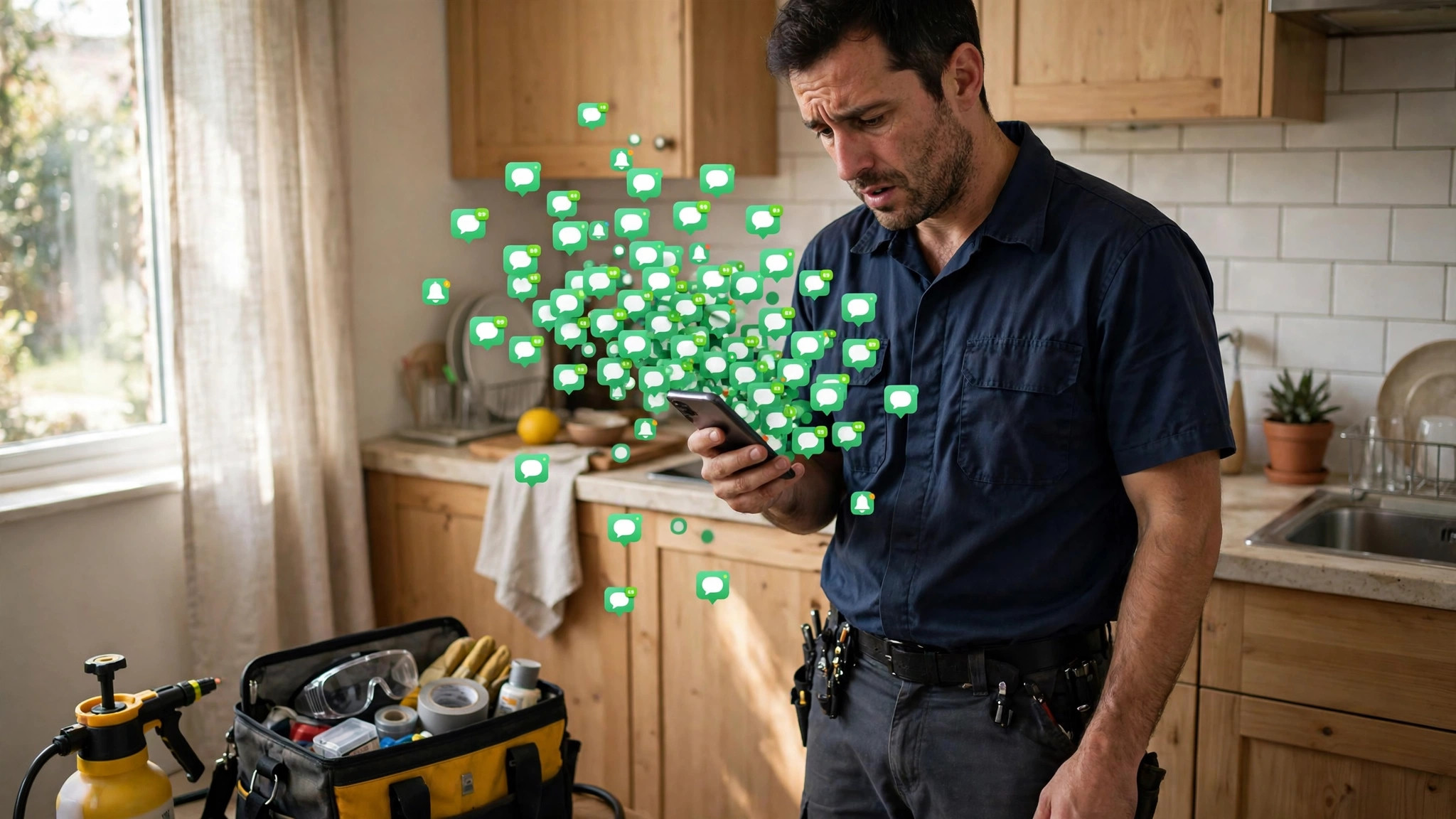
It is 6:40 in the evening and your technician is halfway through treating a kitchen for cockroaches. Gloves on, sprayer in hand, customer watching. On the phone in his pocket, five new WhatsApp messages have just landed. A mother has found wasps nesting by her back door. A restaurant manager needs a treatment certificate before tomorrow's inspection. A landlord wants a quote for bed bugs in a rented flat. Two old customers are asking when their next visit is due. Every one of them will hire someone — and most will hire whoever answers first. WhatsApp automation for pest control companies is an AI assistant on your business number that sorts urgent pest jobs from routine ones, books inspections, sends reminders, and follows up quotes in seconds, day or night. It works because pest problems feel urgent to the person living with them, and the company that replies first usually gets the job. This article shows you exactly what to automate, where the safety lines sit, and how tools like ReplyPilot (AI automation for small-business messaging — WhatsApp, Instagram DM, website chat) fit into a working pest control business.
Why Pest Control Messages Can't Wait
Pest control is an urgency business. Nobody messages a pest control company because they are bored. They message because something is crawling across their kitchen floor, buzzing near their children, or chewing through their stockroom. That fear has a short fuse. If a pest-control firm replies in an hour, that is helpful. If you reply tomorrow, they have already called your competitor — and they will remember the company that picked up, not the one with the better treatment plan.
The second problem is that your team is always somewhere else. When the messages arrive, your technicians are in other people's homes, up ladders, or driving between jobs. Your office, if you even have one, is one person juggling the diary, the invoices, and the phone. A wasp nest does not wait for office hours. Neither does a restaurant that needs paperwork before an inspection. The company that answers first wins, and the company that answers first is almost never the one relying on a human to spot every message.
What WhatsApp Automation for Pest Control Companies Actually Does
Think of it as the calmest member of your team, sitting on the number your customers already message. It knows your services, your service areas, and the way you like jobs booked. It answers in seconds, asks the right questions, and keeps every conversation in one place. It never forgets a follow-up, never loses a quote under a pile of unread chats, and never answers a worried parent with a tired one-liner at 11pm.
- Sorts every enquiry by urgency — wasps, rats and bed bugs jump the queue, routine quotes wait their turn.
- Books inspections in the chat from your real diary, and confirms them the day before so nobody forgets.
- Collects the details a technician actually needs — pest type, photos, address, access notes — before the van leaves.
- Sends treatment reminders and follow-up visit dates so repeat work never slips through the cracks.
- Chases quiet quotes with a polite, well-timed message instead of letting them go cold.
- Hands over to you the moment a conversation needs a human — complaints, unusual pests, anything odd.
Notice what it does not do: it does not diagnose, it does not prescribe chemicals, and it does not replace the technician. It wins the conversation and fills the pest-control diary. Your team does the treating. That split is the entire point, and companies that respect it get the best of both worlds. In pest control, the first reply is the job.
How Does It Tell a Real Emergency From a Routine Job?
Not every pest message is an emergency, but every customer thinks theirs is. The automation's first job is to ask two or three short questions and sort the queue: what pest, where is it, and is anyone at risk? A wasp nest by a school gate is urgent. Ants in a garden shed are not. Rats in a restaurant kitchen sit somewhere in between. The answers decide what happens next, and they decide it in under a minute.
Urgent pest jobs get a fast lane. The assistant tells the customer what happens next — when a technician can come, what it will cost in general terms from your real price list, and what to do meanwhile, using only safety wording you approved in advance. It then flags the job to you with the full thread attached, so you can confirm the slot without re-asking everything. Routine jobs get a calmer path: an inspection booking, a quote, and a reminder. Nobody is ignored. The pest-control queue just stops being first-come, first-served.
Photos make the triage ten times better. A customer who sends a photo of the pest, the droppings, or the damage gives your team a head start before anyone leaves the depot. The assistant asks for the photo early, stores it with the job, and passes it to the technician. A technician who has seen the photo arrives with the right kit, and that alone can save a wasted visit.
The Safety Line: What Must It Never Say?
Pest control deals with chemicals, allergies, children, and pets — so the safety rules are not suggestions. Your assistant must never tell a customer to spray, mix, or handle any product. It must never guess which chemical is safe around a dog, a baby, or a pregnant customer. And it must never promise that a treatment is safe for a specific person or animal. Those answers belong to trained people, and a well-built assistant knows exactly where its own knowledge ends.
- Approved wording only for anything safety-related — 'please keep children and pets away from the treated area until it dries' is a script you write once, not something the assistant invents.
- Instant handoff for bites, stings, allergic reactions, or anyone feeling unwell — the assistant says 'please get medical help first' and alerts you.
- No DIY treatment advice, ever — 'here is how to handle it yourself' is the one answer that can hurt someone and sink your reputation.
- Every safety message logged in the chat, so there is a written record of exactly what was said.
- A plain-language rule your whole team knows: if a question touches health, chemicals, or risk, a human answers it.
Owners sometimes worry this makes the assistant sound limited. It does the opposite. A customer who hears 'that question needs one of our technicians — I have flagged it for them' trusts you more, not less. Honest limits are a selling point in a trade where cowboys promise everything. Speed is the service, but safety is the reputation.
Inspections and Quotes Without the Phone Tag
Most pest control quotes need eyes on the property first, and the booking of that inspection is where jobs quietly die. The customer messages at 9pm, you reply at 9am, they are at work, you miss each other for three days, and by Friday they have booked someone else. The assistant breaks that loop by offering real slots from your diary the moment the customer messages, and locking the booking in the chat while the customer is still thinking about the problem.
The quote itself stays honest. For standard jobs, the assistant quotes your real fixed prices. For everything else, it gives an honest range and books the inspection that turns the range into a firm figure. It says what is included, what the first visit covers, and what a follow-up visit is for. Customers who understand the plan before you arrive argue less, pay faster, and leave better reviews. The same enquiry logic serves neighbouring trades — the approach mirrors what works for home cleaning services and plumbers.
The Contract Engine: Renewals That Run Themselves
One-off jobs pay the bills this month. Contracts pay them all year. Restaurants, offices, warehouses, and landlords need regular visits, and the quiet money in pest control is the contract that renews without a chase. The assistant keeps a record of every contract — what it covers, when the next visit falls due, and when the renewal date arrives — and it does the reminding for you.
A month before renewal, the customer gets a simple message: your plan renews soon, here is what it covered this year, would you like to keep it going? A week before a scheduled visit, they get the reminder. After each visit, they get the report and the next date. Nothing depends on anyone remembering. Contracts that renew themselves are the steadiest income a pest control company can have, and most companies lose them through forgetfulness, not price.
Seasonal Surges: When the Whole Town Calls at Once
Pest control has seasons, and every owner knows the feeling: the first hot week arrives, and suddenly everyone has ants. Then the wasps. Then the rats come indoors as the weather turns. The phone rings ten times a day, your technicians are booked solid, and new customers get a busy signal or a voicemail. Those are the weeks that decide your year — and the weeks when a slow reply costs the most.
Want this for your pest control companies?
ReplyPilot builds a custom whatsapp automation setup for your pest control companies — answering customer questions instantly, taking orders and bookings, and handing off to you when a human is needed.
Ask on WhatsApp — it's freeAutomation does not create more technicians, but it stops the surge from becoming a mess. Every caller gets an instant answer, a place in the queue, and a realistic time. Urgent jobs get flagged. Routine jobs get booked for next week instead of being lost. And when the surge passes, the assistant follows up with the people who waited, so the queue becomes next month's work instead of nobody's. A summer surge handled well is a reputation that lasts all year.
Commercial Clients: Restaurants, Offices and the Paper Trail
Commercial clients buy paperwork as much as pest control. A restaurant needs treatment records for inspections. An office needs a service log. A warehouse needs proof that the bait stations were checked. The assistant collects the job details in the chat, and after each visit it can send the visit summary, the next date, and the documents the client needs — all in the same thread where the job was booked.
The commercial enquiry also arrives at the worst times — the manager messages at 8pm because an inspector is coming at 9am. An instant reply with the service record, the certificate, and a booked visit is the difference between keeping the account and losing it. Commercial clients choose vendors on reliability first. The same diary-first discipline wins work in other local trades too, as the electricians playbook shows.
How Do You Follow Up With Quotes That Go Quiet?
You sent the quote. They said 'thanks, we'll think about it.' Then silence from the caller. This is where pest control revenue quietly leaks away — not in the treatment, but in the follow-up nobody had time to do. The homeowner is not ignoring your business. They are busy, the ants went quiet for a day, and your quote sank below the fold. One well-timed message brings it back to the top of the pile.
The pest-control sequence that works is gentle and specific. Three days after the quote: 'Hi, just checking you got the quote for the wasp nest — happy to adjust anything.' A week later, a reason, not a nudge: 'Wasp nests grow fast this time of year — would you like me to hold a slot for Thursday?' Each message has a reason to exist. None of them beg. And when the answer is a polite no, the assistant thanks them and asks if it can check back next season. A no today is often a yes next summer.
Mistakes That Kill Pest Control Automations
- Letting it give chemical or DIY advice — one invented safety answer can hurt someone and end your business.
- Quoting invented numbers — one wrong price in writing can cost a pest-control firm the client and your name; load only real prices.
- No urgency rules — an assistant that treats a wasp nest like a routine quote will lose the jobs that matter most.
- Forgetting the paper trail — commercial clients leave when certificates and visit records go missing.
- Broadcasting without consent — one spam complaint can endanger the number your pest-control business runs on.
- Launching without testing is a gamble — let it handle ten real pest-control enquiries quietly while you read every chat, then open the gates.
All of these mistakes share one cause: owners treat the automation as software, not as a team member. Train it the way you would train a new hire — real services, real prices, real tone, and clear rules for when to call you. Companies who do this get an assistant. Companies who skip the training get a toy that sends embarrassing messages.
You vs Hiring Help vs Automation: A Simple Comparison
Speed of first reply | You, mid-treatment: hours | Part-time office help: minutes to hours, on shift only | Automation: seconds, around the clock\nAfter-hours cover | You: none | Office help: none, they have gone home | Automation: full cover, same quality\nUrgency sorting | You: excellent until you are tired | Office help: good with a script | Automation: consistent triage on every message\nMemory for details | You: good until the day gets busy | Office help: good with a spreadsheet | Automation: perfect thread memory, every contract date kept\nBest for | You: the treatment itself | Office help: phone calls and walk-ins | Automation: winning the chat before the visit
Most pest control businesses land on a mix: automation wins the enquiry, humans win the job. One extra contract renewal per month covers the running cost many times over, and the same follow-up discipline serves the restaurants you protect — see the restaurants playbook for the commercial side.
Staying Ban-Proof: Rules That Matter
Your WhatsApp number is the lifeline of your business, so the rules are not optional. Only message people who contacted you first or clearly opted in. When you start the conversation, you need consent first, and on the official API you need an approved template. Meta's WhatsApp Business Platform documentation lays out the messaging rules every setup must follow, and it is worth reading before you automate anything.
Put simply: never bulk-message cold numbers, never buy contact lists, and make every broadcast easy to opt out of. A customer who opts out gracefully may still call you next season. One homeowner reporting you as spam can cost you the number. The companies who stay safe treat these rules as customer service, not red tape — and the official setup guide walks through the compliant route step by step.
How Do You Tell It Is Working?
Ignore the vanity numbers in pest control. A pest control business should watch four things. First, booked inspections per month from WhatsApp — the number that pays. Second, quote-to-booking conversion — what share of quotes turn into visits. Third, reply time — it should sit under a minute, every time. Fourth, contract renewals — they should climb once reminders go out. These four pest-control numbers tell you everything.
Check them on the first day of every month. If inspections are climbing and renewals are holding, the automation is earning its keep. If not, the problem is almost always the answers you loaded — the services, the prices, the tone. Fix the pest-control knowledge, not the tool. A 98% open rate with zero new bookings is a vanity metric, and vanity metrics do not pay for vans.
Putting It Together: Your Opening 30 Days
Step 1: Write your pest-control team's real answers. Your ten most-asked questions — pest types, inspection process, price ranges, safety rules — in your own words. This document becomes the assistant's brain.\nStep 2: Set the triage rules. Write the plain-language list of what counts as urgent, what counts as routine, and what always goes to a human.\nStep 3: Connect your diary. Give the assistant read-and-write access to your job calendar so every slot it offers is real.\nStep 4: Run a quiet week. Let it handle new enquiries while you read every chat and correct the tone.\nStep 5: Switch on follow-ups and renewals. Once the daily replies feel right, add the quote follow-ups and the contract reminders.
Do not try to automate the whole pest-control operation on day one. The companies who win start with enquiries and inspection bookings, watch for a week, then add the rest. Slow is smooth, and smooth is fast in pest control. If you want this running before the next seasonal surge, request a free custom demo at https://replypilot-site.vercel.app/ — ReplyPilot (AI automation for small-business messaging — WhatsApp, Instagram DM, website chat) builds the assistant around your services, your diary and your tone, so it sounds like your team from the very first message.
Frequently Asked Questions
Can WhatsApp automation really sort urgent pest jobs from routine ones?
Yes — it asks two or three short questions about the pest, the location, and any risk, then routes the job to the right queue. Urgent jobs get a fast lane and a flag to your team, while routine jobs get an inspection booking. You set the triage rules, so the sorting always matches how your business actually works.
Will it give customers chemical or DIY pest control advice?
No — not if your pest-control setup is built properly. Every safety answer comes from wording you approve in advance, and anything touching chemicals, health, or risk hands over to a human instantly. A well-built pest control assistant never tells a customer to spray, mix, or handle any product. That is a hard rule.
How does it handle inspection bookings?
It offers real slots from your connected diary, confirms the booking in the chat, and asks for the details a technician needs — pest type, photos, address, and access notes. A reminder the day before keeps no-shows low, and the technician arrives knowing what to expect.
Can it manage service contracts and renewals?
Yes, and this is one of a pest-control assistant's best uses. It tracks what each contract covers, when the next visit falls due, and when renewal arrives. It sends visit reminders, renewal messages, and post-visit summaries automatically, so contracts renew themselves instead of quietly lapsing.
Is it safe to send promotional messages to past customers on WhatsApp?
Only with their consent. Broadcast to people who opted in — past customers and enquirers who said yes — and keep messages rare and relevant. Cold bulk messages risk your number being flagged, which is the last thing a pest control business needs.
How long does setup take for a pest control company?
About a month done properly: one week writing your real answers and triage rules, one week connecting the diary and testing quietly, then two weeks of live enquiries with you watching and refining the tone. Many companies see faster first replies within the first few days.