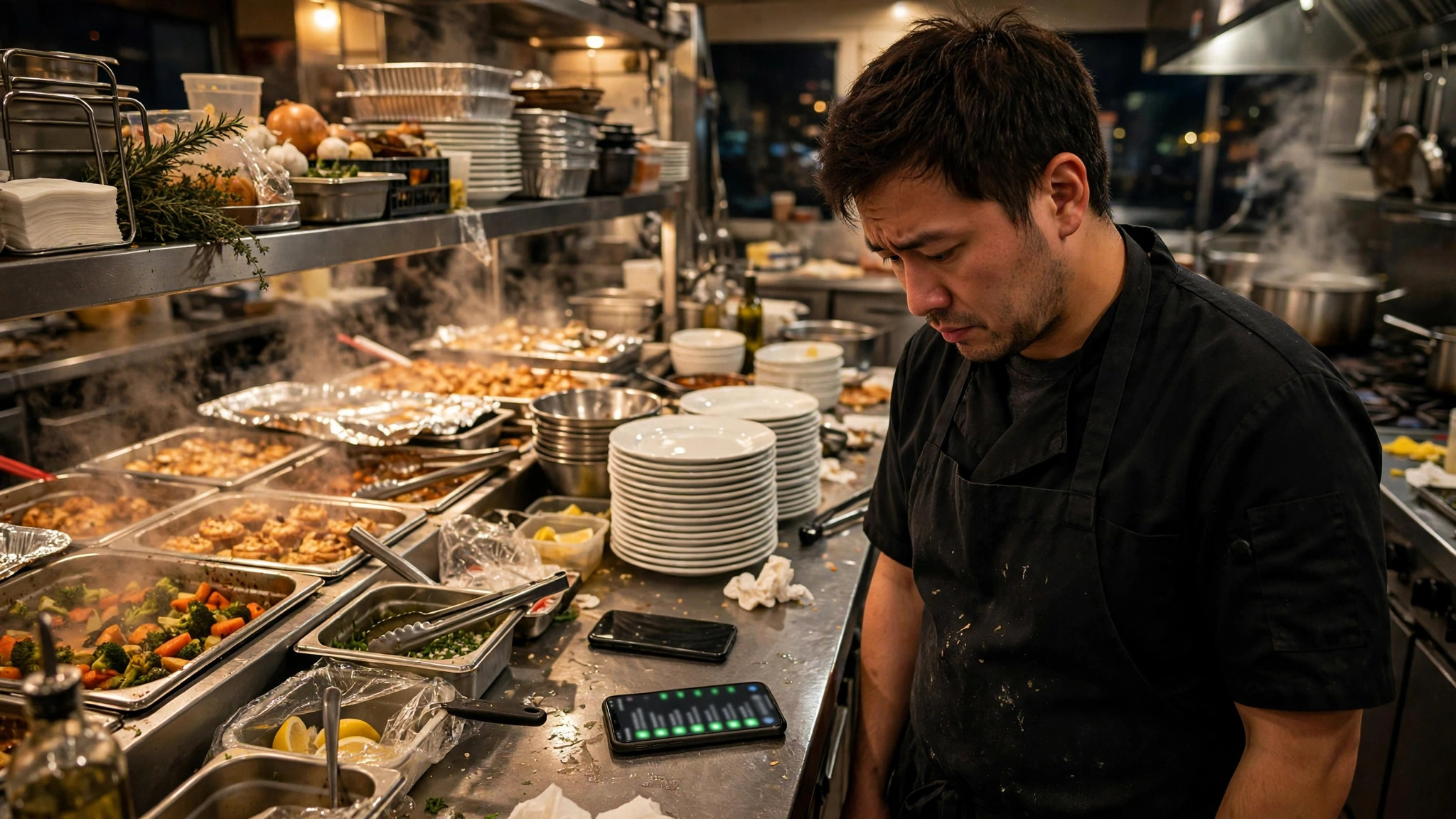
It is Thursday evening and your whole team is deep in prep for a 200-guest wedding on Saturday. Trays are sliding into the oven, the delivery run for tomorrow is half-planned, and nobody has looked at their phone in three hours. Meanwhile, on your business WhatsApp, four real clients are waiting. A bride wants a quote for 150 guests in December. An office manager needs a tasting slot for next week. A birthday mum asks whether you do children's menus. Every one of them will book someone — the only question is whether it is you. WhatsApp automation for caterers means an AI assistant on your business number that answers quote requests, books tasting slots and follows up with event planners in seconds, day or night. It works because catering clients plan events at strange hours and shortlist the caterer who replies first, not the one with the finest kitchen. A reply in a minute wins the tasting; a reply tomorrow morning loses the job to whoever answered quicker. This article shows you exactly what to automate, what to keep human, and how tools like ReplyPilot (AI automation for small-business messaging — WhatsApp, Instagram DM, website chat) fit into a busy catering operation.
Why Your Phone Blows Up Exactly When You Can't Touch It
Catering has a cruel timing problem. Your busiest hours in the kitchen are also the busiest hours for new enquiries. People plan weddings on Sunday afternoons, office parties during lunch breaks, and birthday dinners at 11pm after the kids are asleep. Those are precisely the hours you are cooking, serving, or finally resting. Your competitors have the same problem — which means the caterer who answers first wins far more often than the caterer who cooks best. Speed is doing half the selling before the food ever enters the conversation.
The second timing problem is the event calendar itself. Wedding season, summer parties, Eid gatherings, corporate year-end dinners — enquiries arrive in waves, and the wave does not wait for your kitchen to quiet down. A quote request that sits unread for two days is not a delayed quote. It is a lost client who has already tasted someone else's menu and told their friends about it. In catering, a slow reply does not just lose one event. It loses the referrals that event would have produced.
What WhatsApp Automation for Caterers Actually Does
Think of it as the most reliable member of your front-of-house team, except it lives inside WhatsApp on the number your clients already message. It knows your menus, your price ranges, your tasting process, and your delivery areas. It answers instantly, politely, and in the same tone every time — at 2pm on a Tuesday and at midnight on a Friday. It never forgets a follow-up, never answers with a tired one-liner at 11pm, and never buries a quote request under a pile of read-later messages.
- Answers quote requests with your real price ranges and the right questions — guest count, date, venue — instead of 'call us Monday'.
- Books tasting sessions in the chat from your real calendar, and confirms them the day before so nobody no-shows.
- Sends menus as readable messages, not PDFs nobody opens, and flags dietary options when asked.
- Follows up warmly with quotes that went quiet — once, twice, with a real reason each time.
- Collects deposits and final guest counts, with written confirmation saved in the chat history.
- Hands over to you the moment a conversation needs a human — big budgets, unhappy clients, unusual requests.
Notice what it does not do: it does not replace the tasting, the site visit, or you. Nobody books a wedding caterer from a machine alone. The automation wins the conversation and fills your diary. You win the kitchen. That split is the entire point, and caterers who respect it get the best of both worlds.
How Does WhatsApp Automation Send an Event Quote in Minutes?
A quote is really three things: the right questions, your real numbers, and a fast answer. The automation asks the questions you would ask on the phone — event date, guest count, venue, service style — and it asks them in a chat, where people actually answer. Nobody enjoys a phone interrogation at 10pm, but almost everyone will tap through four quick questions on WhatsApp while sitting on the sofa. The questions arrive one at a time, feel conversational, and take the client under a minute.
Then it replies with your genuine price range, written the way you would say it. 'For 120 guests with a buffet service in December, most of our clients spend between X and Y per head.' No invented numbers, ever — you load your real ranges in once, and the assistant only ever quotes those. It names what is included, what costs extra, and the next step: a tasting, a site visit, or a call with you. The quote reads like you wrote it, because in a sense you did.
The speed is the whole trick. A quote that arrives in three minutes while the client is still excited beats a quote that arrives in three days when they have already shortlisted two others. Caterers who quote fast notice a simple change: more tastings booked, fewer 'just checking prices' ghosts. The quote does not need to be clever. It needs to be fast, honest, and followed by a real next step.
Tastings: The Booking That Wins the Wedding
For weddings and big events, the tasting is the sale. Nobody commits thousands without tasting the food first. So the tasting booking is the single most valuable conversion your WhatsApp can produce, and it deserves the smoothest possible path. The assistant offers real slots from your calendar, confirms the booking in the chat, and tells the client exactly what to expect — how many guests can come, how many dishes they will try, and how long the whole thing takes.
The details around the tasting matter more than most owners think. Send the address with parking notes the evening before. Remind them on the morning of. Ask about allergies in advance so the chef is ready. Each of these small touches says 'this caterer has their act together' before a single dish is served. And when the tasting goes well, the assistant can send the quote recap in the same thread — the yes often arrives within the hour, while the flavours are still fresh in everyone's mind.
The Menu Maze: Dietary Requirements, Guest Counts and Late Changes
Catering conversations are never one message and done. The guest count changes. The bride's mother is vegetarian. Ten guests need halal options. Three are gluten-free. The venue bans open flames. Every one of these arrives as a separate message, often weeks apart, and every one needs a confident answer. This is where an automation quietly outperforms a tired human — it remembers the whole thread. Nothing gets lost between your phone, your notebook and your head.
- Keeps a running note of guest count, dietary needs and venue rules per event, updated with every message.
- Answers 'do you do vegan options?' with your real vegan dishes, not a vague yes.
- Flags changes that affect price — 'going from 100 to 130 guests moves the quote to X' — before they become arguments.
- Sends the final menu confirmation in writing, which ends 'but you said' disputes.
- Reminds clients of final-numbers deadlines so your kitchen can actually plan ahead.
The honest-limits rule applies here. An assistant that invents a dish you do not cook is worse than no assistant at all. You load your real menus once — including what you cannot do — and the assistant works only from that. 'We don't do live cooking stations, but here's what we do instead' is an honest answer that keeps trust. Caterers who are honest about their limits win more weddings than caterers who promise everything and scramble later.
How Do You Follow Up With Planners Who Go Quiet?
You sent the quote. They said 'looks great, we'll discuss'. Then silence. This is where most catering revenue quietly dies — not in the kitchen, but in the follow-up nobody had time to do. Event planners and brides are not ignoring you; they are juggling ten vendors and your quote sank below the fold. One well-timed message brings it back to the top of the pile, and the caterer who follows up usually beats the caterer who quoted first.
The catering sequence that works is gentle and specific. Three days after the quote: 'Hi Sarah, just checking you received the quote for December 12th — happy to adjust anything.' Ten days later, a reason, not a nudge: 'Our December Saturdays are filling up — would you like me to hold yours while you decide?' Each message has a reason to exist. None of them beg. And when the answer is a polite no, the assistant thanks them and asks if it can check back next season — a no today is often a yes next year.
Corporate planners deserve their own rhythm. They decide in committees and need ammunition — the assistant can send a one-page summary of the quote, the menu, and your food-safety credentials for the internal meeting. You are not following up; you are helping them sell you to their boss. That is a completely different message, and it works far better than 'just checking in'.
Corporate Clients: The Repeat Business That Pays the Bills
Want this for your caterers?
ReplyPilot builds a custom whatsapp automation setup for your caterers — answering customer questions instantly, taking orders and bookings, and handing off to you when a human is needed.
Ask on WhatsApp — it's freeWeddings are glorious, but corporate lunches are the bills-payers. One office that orders Friday lunch every week is worth a dozen one-off parties, and corporate clients choose vendors the way they choose everything else: reliability first. The assistant's job here is to make ordering boringly easy — saved menus, saved headcounts, one message to reorder. A weekly standing order handled in two messages is a client that never shops around.
The corporate enquiry also arrives at the worst times — the office manager messages at 7pm because the boss asked at 6:55. An instant reply with the menu and a quote for 40 people, plus 'we can deliver by 12:30 on Thursday', is the difference between winning the account and being one of five quotes she requested. Speed plus reliability is the whole corporate game, and it is a game an automation plays perfectly.
The reordering habit is where corporate catering gets truly effortless. Once an office has ordered twice, the assistant knows the drill — headcount, dietary notes, delivery time — and the third order is a two-message exchange. Offices that order easily order often. And when the office manager moves to a new company, she takes her favourite caterer with her. That is how one good corporate account quietly becomes three.
Broadcasts That Fill Your Slow Season
Every caterer has a slow season — the weeks after the wedding rush, or the deep winter lull when events dry up. Your WhatsApp list — past clients and enquirers who said yes to updates — is the cheapest way to fill it. A message like 'We've opened three December tasting weekends — past clients book first, want a slot?' can fill a month before you spend a penny on ads. These people already trust your food. You are just reminding them you exist.
The line between welcome and spam is consent plus value. Only message people who opted in. Only message about things worth their attention — new menus, tasting weekends, seasonal packages. A caterer's list is an invitation list, not a megaphone. ReplyPilot (AI automation for small-business messaging — WhatsApp, Instagram DM, website chat) can manage the opt-ins and handle the replies to each broadcast, booking the tastings straight from the announcement thread.
Event Day Chaos and the Review Gold Mine
On event day, your phone becomes a liability. The client messages 'the van is at the wrong gate', a guest asks about allergens, the venue coordinator needs the final headcount — all while your hands are full of trays. Route event-day messages to the automation for the predictable stuff: gate directions, schedule confirmations, allergen answers from the loaded menu. Anything unusual goes straight to you, with the full thread attached, so you pick up mid-conversation.
The day after the event is the gold mine most caterers walk past. Guests are still talking about the food, and the client is glowing. A warm message — 'Hope yesterday went beautifully! If you have a moment, a quick review would mean the world to us' — sent at the right moment collects reviews when feelings are warmest. Reviews are the fuel of catering bookings, and this single message is the easiest marketing you will ever do.
Photos are the other half of the gold mine. Ask happy clients to share their event photos, and with permission, let the assistant collect them into a simple gallery you can show future clients. A bride choosing between two caterers will pick the one whose past weddings she can see. Every event you cater is a showroom for the next ten — but only if someone remembers to collect the evidence.
Mistakes That Kill Catering Automations
- Quoting invented numbers — one wrong price in writing can cost you the client and your reputation; load only real ranges.
- Sounding like a robot at a wedding — this is an emotional purchase; every message must read like your best team member wrote it.
- No handoff rules — an assistant that argues with an upset mother-of-the-bride is worse than no assistant at all.
- Forgetting the event-day plan — if the automation goes quiet on the day it matters most, clients lose faith in the whole setup.
- Broadcasting without consent — one spam complaint can endanger the number your catering business runs on.
- Launching on your real menus without testing — let it handle ten real enquiries quietly while you watch, then open the gates.
The pattern behind every one of these mistakes is the same: owners treat the automation as software instead of as a team member. Train it the way you would train a new front-of-house hire — real menus, real prices, real tone, and clear rules for when to call you. Caterers who do this get an assistant. Caterers who skip the training get a toy that sends embarrassing messages.
Answering Yourself vs Hiring Help vs Automation: A Simple Comparison
Speed of first reply | You, between services: hours | Part-time coordinator: minutes to hours, on shift only | Automation: seconds, around the clock\nAfter-hours cover | You: none | Coordinator: none, they have gone home | Automation: full cover, same quality\nMemory for details | You: excellent until you are tired | Coordinator: good with a spreadsheet | Automation: perfect thread memory, every dietary note kept\nCost pattern | You: your own evenings | Coordinator: monthly salary plus training | Automation: a monthly plan plus per-message fees\nBest for | You: the tasting and the event itself | Coordinator: phone calls and walk-ins | Automation: winning the chat before the visit
Most catering businesses land on a mix: automation wins the enquiry, humans win the event. One extra wedding booking per month covers the running cost many times over, and the same enquiry logic serves neighbouring food businesses — the approach mirrors what works for restaurants and food trucks.
Staying Ban-Proof for Caterers: The Rules That Matter
Your WhatsApp number is your business lifeline, so the rules are not optional. Message only people who contacted you first or explicitly opted in. Business-initiated messages need consent and, on the official API, approved templates. Meta's WhatsApp Business Platform documentation sets out the messaging rules every setup must follow, and it is worth reading before you automate anything.
The practical version: never bulk-message cold numbers, never buy contact lists, and make every broadcast easy to opt out of. A client who opts out gracefully may still book you next season. A client who reports you as spam costs you your number. The caterers who stay safe treat these rules as customer service, not red tape — and the official setup guide walks through the compliant route step by step.
How Do You Know the Catering Automation Is Working?
Ignore the vanity numbers in catering. A catering business should watch four things. First, tasting bookings per month from WhatsApp — the number that pays. Second, quote-to-tasting conversion — what share of quotes turn into tastings. Third, response time — it should sit under a minute, always. Fourth, the no-show rate on tastings — it should fall once confirmations go out. These four catering numbers tell you everything.
Check them on the first Sunday of every month. If tastings are climbing and no-shows are falling, the automation is earning its keep. If not, the problem is almost always the answers you loaded — the menus, the prices, the tone. Fix the catering knowledge, not the tool. A 98% open rate with zero new tastings is a vanity metric, and vanity metrics do not pay for ovens.
Putting It Together for Your Catering Business: The First 30 Days
Step 1: Write your catering team's real answers. Your ten most-asked questions — price ranges, the tasting process, delivery areas, dietary handling — in your own words. This document is the assistant's brain — next comes Step 2: Connect your calendar. Give the assistant read-and-write access to your tasting calendar so every slot it offers is real.\nStep 3: Set the handoff rules. Write the plain-language list of when it brings you in — big budgets, upset clients, anything odd.\nStep 4: Run a quiet week. Let it handle new enquiries while you read every chat and correct the tone.\nStep 5: Switch on follow-ups and broadcasts. Once the daily replies feel right, add the quote follow-ups and the slow-season announcements. A practical walkthrough of one catering-style setup is shown in this catering chatbot build guide.
Do not try to automate the whole catering operation on day one. The caterers who win start with enquiries and tasting bookings, watch for a week, then add the rest. Slow is smooth, and smooth is fast in catering. If you want this running before your next wedding season, request a free custom demo at https://replypilot-site.vercel.app/ — ReplyPilot (AI automation for small-business messaging — WhatsApp, Instagram DM, website chat) builds the assistant around your menus, your calendar and your tone, so it sounds like your team from the very first message.
Frequently Asked Questions
Can WhatsApp automation really send accurate quotes for my catering business?
Yes — but only if you load your real price ranges first. The assistant quotes the numbers you give it, asks the right questions about guest count, date and service style, and never invents figures. Think of it as your best estimator answering in seconds instead of days.
Will clients know they are talking to an automated assistant?
A well-built one sounds like your business, not a machine — warm, knowledgeable and quick. Most clients never think about it. The goal is not to trick anyone; it is to give instant, helpful answers, and to hand over to you the moment a conversation needs a human.
How does it handle tasting bookings?
It offers real slots from your connected calendar, confirms the booking, and sends the practical details — address, parking notes, how many guests can come, and allergy questions for the chef. A reminder the day before keeps no-shows low.
What about last-minute changes to guest counts or menus?
The assistant keeps a running note of every event's details and updates it with each message. It flags changes that affect the price before they become disputes, and sends the final menu confirmation in writing so everyone agrees on what was ordered.
Is it safe to send promotional messages to past clients on WhatsApp?
Only with their consent. Broadcast to people who opted in — past clients and enquirers who said yes — and keep messages rare and relevant. Cold bulk messages risk your number being flagged, which is the last thing a catering business needs.
How long does setup take for a catering business?
About a month done properly: one week writing your real answers, one week connecting the calendar and testing quietly, then two weeks of live enquiries with you watching and refining the tone. Many caterers see faster quote replies within the first fortnight.