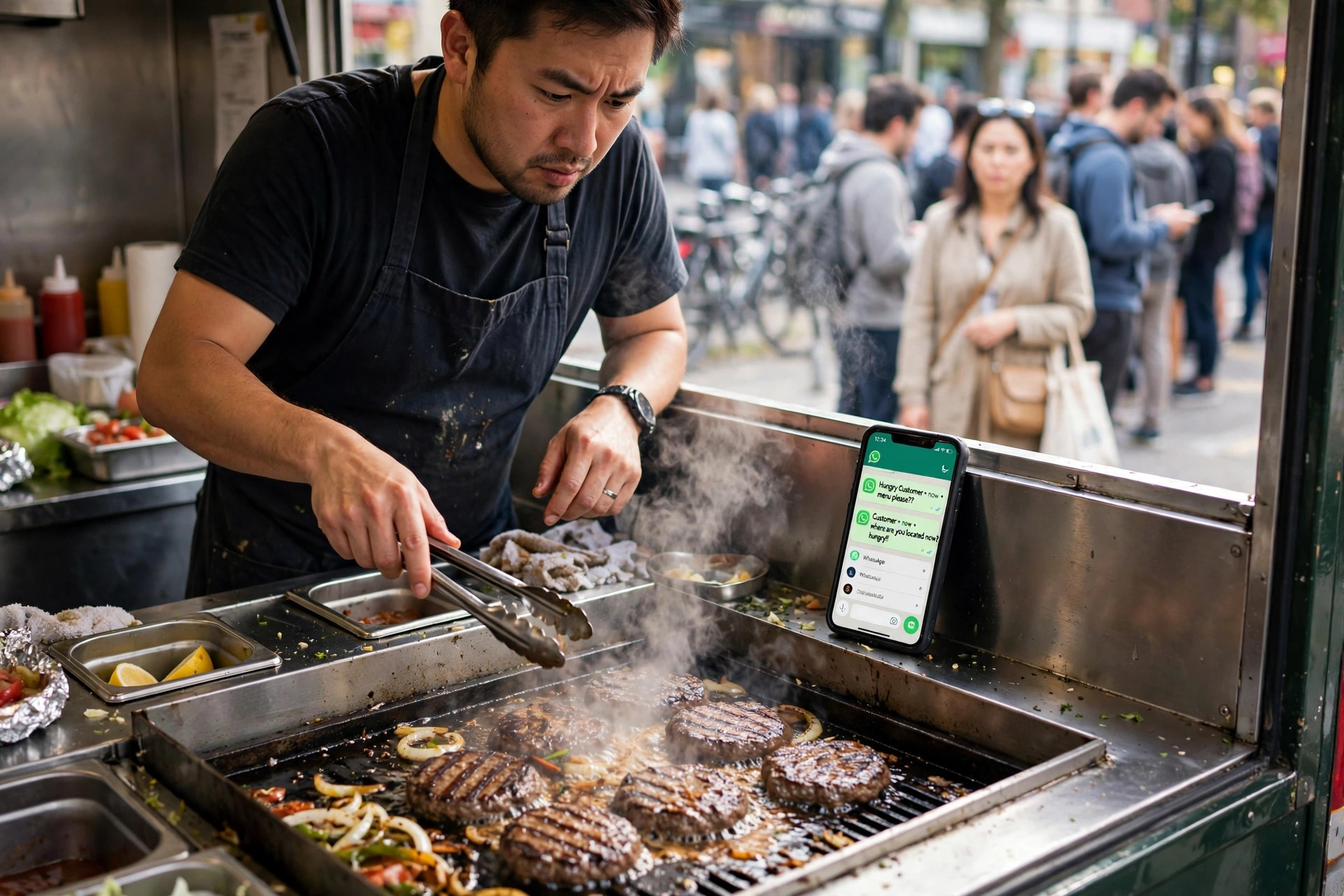
It is 12:40 on a Friday and your truck is parked outside the office park. The grill is loaded, the line stretches past the second lamppost, and your phone is buzzing on the shelf above the fryer. 'Menu please?' 'Where are you today?' 'Can I order 4 burgers for pickup at 1?' 'Do you come to Riverside on Saturdays?' Four customers with money in their pockets, and your hands are covered in grill grease. You will answer at 4pm, long after the lunch crowd has eaten somewhere else. WhatsApp automation for food trucks means an AI assistant that answers those messages the second they arrive. It sends your menu, takes pre-orders for pickup, tells everyone where you are parked today, and announces your specials and next stop without you touching the phone. For a food truck, the best approach is chat-based automation because your customers' questions are urgent and simple - what is on the menu, where is the truck, can I order ahead - and a reply that arrives in seconds turns a hungry scroller into a paying customer, while a reply that arrives tonight turns them into someone else's regular.
Why the Lunch Rush Is the Worst Time to Answer Messages
A food truck has a brutal maths problem. Your peak earning window is about ninety minutes, and it is also the only time you cannot answer the phone. Every minute you spend reading messages is a minute the grill goes unmanaged and the line goes unserved. But those ninety minutes are exactly when the messages arrive - hungry office workers deciding where to eat right now, this minute, from their desks.
The food truck business runs on impulse. Nobody plans a food truck visit three days ahead; they see the truck, smell the food, or hear about it in the office chat, and they decide in seconds. If your WhatsApp answers instantly with the menu and your location, you capture the impulse. If it answers at 4pm, the impulse bought a sandwich from the deli across the street. Speed is not a nice-to-have here. It is the business.
A hungry customer who waits twenty minutes for a menu reply has already eaten elsewhere. Pin that above the fryer. Every food truck owner knows this in their gut; automation is how you finally act on it without growing a second pair of hands.
What WhatsApp Automation for Food Trucks Actually Does
Picture your sharpest crew member - the one who knows the menu by heart, remembers the regulars, and can take an order while flipping burgers. Now imagine she works the chat instead of the grill, never takes a break, and handles fifty conversations at once. That is what the automation does on your existing WhatsApp number, which customers already message.
- Sends your menu instantly - with photos, prices and today's specials - the moment anyone asks.
- Takes pre-orders for pickup: item, quantity, name, pickup time, confirmed in writing.
- Answers 'where are you today?' with your current spot, hours and parking notes.
- Broadcasts your weekly schedule and daily location to your opted-in list.
- Collects catering and event enquiries with the details you need to quote.
- Hands over to you when a message needs a human - complaints, big orders, anything odd.
None of this asks your customer to download an app or learn a system. They message you the way they message their friends, and the truck answers like it has a dedicated person on the phone - because, in a way, it does. Your regulars will not even notice the difference; they will only notice that you always reply.
How Does WhatsApp Automation Take Pre-Orders During a Rush?
This is the money feature. A customer messages '2 chicken burgers and a loaded fries, pickup 12:45'. The assistant confirms the order in writing - items, quantities, total, name, pickup time - and adds it to your order list. The customer skips the line, you get a confirmed sale without a single phone call, and the grill gets a steady flow of timed orders instead of a chaotic queue.
The written confirmation is the quiet hero here. 'Order confirmed: 2 chicken burgers, 1 loaded fries - total payable on pickup, ready at 12:45 for Sam.' No misheard orders over a noisy street, no 'I said no onions' arguments, no forgotten pickup times. Everything is in the chat, which both sides can read. Food trucks that take pre-orders this way serve more customers per hour with less stress - the queue moves faster because half of it ordered ahead.
Set a simple cutoff rule and let the assistant enforce it: orders for the 12 o'clock wave close at 11:30, for example. The assistant tells latecomers the next available pickup time instead of overloading your grill. Your food quality stays high because your workload stays sane.
Where Are You Today? Ending the Location Confusion
A food truck's address changes daily, and that is its biggest marketing problem. 'Where are you today?' is the message that eats your morning - asked ten times before you have even lit the grill. The assistant answers it once, perfectly, for everyone: your spot today, your hours, the nearest landmark, and where to park. Update the location each morning in thirty seconds and every customer gets the right answer all day.
Go one step further with a morning broadcast to your opted-in list: 'We are at the Riverside office park today until 2:30 - the pulled-pork special is back.' That single message turns followers into a lunch queue. Regulars start planning their day around your location instead of discovering you by accident. The trucks with the steadiest trade are the ones whose customers always know where to find them.
What Should the Chatbot Do When a Customer Asks About the Menu?
Menu questions seem simple but they hide a trap: your menu changes. Today's special, the item that sold out at noon, the vegetarian option you added last week. The assistant answers from your real, current menu - with photos - so nobody orders the thing that ran out two hours ago. When something sells out, you update it once and the assistant stops offering it to everyone.
Photos matter enormously here. A text menu says 'loaded fries'; a photo of loaded fries sells loaded fries. The assistant sends the photo menu on request, highlights the daily special with its photo, and answers the follow-ups - 'is it spicy?', 'do you have a veg option?', 'what is in the special sauce?' - from your real answers. Food is visual; your chat should be too.
Dietary questions deserve honest answers, not guesses. 'Is the burger halal?' 'Do you have gluten-free bread?' 'Any nut-free desserts?' The assistant answers only what you have told it, and hands over anything uncertain. One wrong allergy answer is worse than a slow answer. Train the menu answers like you would train a new crew member - carefully, completely, truthfully.
Specials, Sold-Outs, and the Broadcast That Fills Your Evening Spot
The daily special is a food truck's secret weapon, and WhatsApp is how you fire it. A mid-morning message to your list - 'Today only: the biryani box is back, 60 portions, we are at the market square until 9pm' - creates the urgency that fills a dinner service. Scarcity plus a photo plus a location is the formula. ReplyPilot (AI automation for small-business messaging - WhatsApp, Instagram DM, website chat) manages these broadcasts so they only reach people who asked to hear from you - your regulars, not random numbers.
Sold-out announcements work the same way in reverse. When the special is gone, one update stops the disappointment messages: 'The biryani boxes are finished for today - back Thursday. The full menu is still on.' Customers respect a truck that tells them the truth quickly. They resent walking ten minutes for a sold-out special.
Keep broadcasts rare and worth opening - one or two a day at most, each with real news. A list that hears from you only when something good is happening gets opened every time. A list that hears daily noise gets muted. Your assistant can schedule the morning location message and the special announcement automatically; you just approve the words.
Catering Enquiries: Catching the Big Orders You Keep Missing
Somewhere in your unread messages is an office manager who wants your truck at their company event for 200 people. Catering enquiries are high-value, slow to arrive, and easy to miss - they come as vague messages like 'do you do events?' and need a proper conversation. The assistant treats these like gold: it collects the date, location, headcount, service style and budget range, then alerts you immediately with a neat summary.
Want this for your food trucks?
ReplyPilot builds a custom whatsapp automation setup for your food trucks — answering customer questions instantly, taking orders and bookings, and handing off to you when a human is needed.
Ask on WhatsApp — it's freeThe key is the instant first reply. An event organiser messages three trucks and books the one that responds first with a professional answer. Your assistant replies in seconds with your catering basics - minimums, service area, what you need from them - and tells them you will confirm the details personally today. You get the enquiry warm and complete instead of cold and half-remembered from a voicemail.
Handling Complaints Without Burning the Brand
Street food is emotional - a cold burger or a long wait feels personal. Complaints arrive hot and fast on WhatsApp, often with photos. The assistant's job is to cool the moment, not to argue: acknowledge immediately, apologise sincerely, and hand over to you with the full story attached. 'I am really sorry about that - let me get the owner, he will sort this out right now.'
Speed of acknowledgement is everything. A customer who gets 'we hear you, the owner is on it' in thirty seconds stays reasonable. A customer who gets silence for three hours writes the review instead. And here is the part owners miss: a complaint handled brilliantly in public earns you more customers than a hundred perfect services, because people trust a business that fixes its mistakes fast. You still handle the fix personally - a refund, a free meal, a real apology - but the assistant makes sure no complaint sits unanswered while you are mid-rush. The trucks with the best reputations are not the ones that never mess up; they are the ones that answer fastest when they do.
Mistakes That Wreck Food-Truck Automations
- An outdated menu - one sold-out item offered all afternoon tells customers you do not pay attention.
- Wrong location answers - a stale 'where are you' reply sends hungry people to an empty parking lot.
- Arguing with complaints - the assistant should soothe and hand over, never debate.
- Broadcasting too often - daily noise gets your list muted; save messages for real news.
- No pre-order cutoff - taking unlimited timed orders overloads the grill and ruins quality.
- Forgetting the regulars - the assistant should greet repeat customers by name and remember their usual.
Every one of these mistakes comes from the same root: stale information. A food truck changes daily - location, menu, stock - so the assistant needs a thirty-second morning update as part of your routine. Lights on, grill on, location updated. Make it a habit and the system stays sharp.
Manual Phone vs Food Apps vs Automation: A Simple Comparison
Speed of reply | You, mid-rush: hours | Food delivery apps: instant but takes a big commission | Automation: seconds, no commission\nMenu control | You: whatever you remember | Apps: their format, their rules | Automation: your photos, your words, updated daily\nCustomer data | You: lost with the chat | Apps: the app owns your customers | Automation: your list, your regulars, your business\nLocation updates | You: answered one by one | Apps: GPS pins, limited reach | Automation: broadcast to your whole list in one message\nCost pattern | You: your evenings | Apps: commission on every order | Automation: monthly plan plus per-message fees, orders are yours
Delivery apps bring you customers at a steep price and keep the relationship. Automation keeps the relationship and the margin. Most successful trucks use both - apps for discovery, WhatsApp for the regulars who are worth ten times more.
Your First 30 Days: Rolling This Out Between Services
Step 1: Write your real menu and answers. The full menu with photos, prices, dietary facts, your catering basics, and the answers to your ten most-asked questions.\nStep 2: Set your daily update habit. Each morning: today's location, hours, and any sold-out or special items. Thirty seconds, every day.\nStep 3: Switch on pre-orders. Start with pickup orders only, with a clear cutoff time. Watch one lunch service and adjust.\nStep 4: Build your list. Add a small sign on the truck: 'Message us on WhatsApp for the daily location and specials.' Every regular who joins is future revenue.\nStep 5: Add broadcasts and catering capture. Once the daily flow is smooth, switch on the morning location broadcast and the catering enquiry flow.
Do not launch the whole food-truck setup on day one. Start with menu answers and location replies, add pre-orders in week two, broadcasts in week three. Each layer should feel boring and reliable before the next one goes on.
Measuring What Matters for Your Food Truck (Beyond 'Messages Answered')
Four numbers tell the truth for a truck. Pre-orders per service - your new revenue line. Average reply time - under a minute, always. List size and broadcast opens - your regulars army, growing weekly. Catering enquiries captured - the big orders that used to slip away.
A 95% open rate with flat pre-orders is a vanity metric. Watch the numbers every Sunday. If pre-orders climb and the lunch line moves faster, the system is working. The same impulse logic drives sit-down service too - see WhatsApp automation for restaurants and the broadcast playbook for the full picture.
How Do You Turn First-Time Visitors Into Regulars?
A food truck's best customer is the one who comes back every Friday. The problem is that most first-time visitors are one accidental encounter away from never returning - they ate well, they meant to come back, and then life happened. The assistant fixes this with a simple thank-you message after the first order: 'Glad you tried us today - we are at the office park every Friday, and the WhatsApp list gets the menu first.'
That one message does two jobs: it reminds them you exist on a schedule, and it invites them onto your broadcast list, which is where the real value lives. Over a few months, the list becomes an asset worth more than any single day's takings - hundreds of hungry regulars who plan their lunch around your truck. Trucks that build this list stop depending on foot traffic luck; they arrive to a queue that was booked by a message.
The follow-up after a first visit should feel like gratitude, not marketing. No discounts needed - just the schedule, the invitation, and a warm tone. Regulars are built on reliability and recognition, and the assistant delivers both: it greets repeat customers by name and remembers their usual order, which is the digital version of the nod and the smile that keeps people coming back to any good food spot.
Staying Ban-Proof for Food Trucks: The Rules That Matter
Your WhatsApp number is your shopfront - a ban closes the shop. Only message people who contacted you first or opted in to your list. Location broadcasts and special announcements go to your opted-in regulars, never to cold numbers or scraped lists. Meta's Business Platform documentation spells out the consent and template rules every food-truck setup must follow.
The practical version for a truck: the sign on your hatch builds the list, the list gets the good news, and anyone can leave the list with one word. Never buy numbers, never blast the neighbourhood. A regular who opts out politely still buys lunch. A stranger reporting you can cost you the number.
What It Costs to Run
Two parts: the automation platform's monthly plan and WhatsApp's per-message fees for business-initiated messages. Replies inside an open customer chat cost less than starting new conversations, so an assistant that answers the menu question fully the first time is also the cheapest kind. This matters more than ever right now - WhatsApp Business changed its pricing in October 2026, and food businesses are rethinking every message they send. An assistant that confirms a pre-order in one clean message instead of a ten-message back-and-forth is built for exactly this moment.
The honest maths: if pre-orders add even a handful of extra sales per service and one catering enquiry a month turns into a booking, the system pays for itself many times over - with zero commission taken from any order. Compare that with the commission slice delivery apps take from every single sale.
Want the lunch rush to run itself in the chat? Request a free custom demo at https://replypilot-site.vercel.app/ and see your own menu answered live. ReplyPilot builds the assistant around your real menu, your daily locations and your tone - the same engine that powers pizza restaurants on WhatsApp, tuned for life on four wheels.
Frequently Asked Questions
Can WhatsApp automation really take food orders for my truck?
Yes. It takes pre-orders for pickup - items, quantities, name and pickup time - and confirms everything in writing so there are no misheard orders. You set a cutoff time so the grill never gets overloaded, and the assistant tells latecomers the next available slot.
How do customers know where my truck is each day?
Anyone who asks 'where are you today?' gets your current location, hours and parking notes instantly. You update the location once each morning in about thirty seconds. A morning broadcast to your opted-in list turns followers into a planned lunch queue.
What happens when my menu changes or something sells out?
You update the menu once - in the same thirty-second morning routine - and the assistant immediately stops offering sold-out items to everyone. Stale menus are the number one killer of food-truck automations, so the daily update habit is non-negotiable.
Can it handle catering and event enquiries?
Yes, and this is where it earns serious money. It replies instantly with your catering basics, collects the date, location, headcount and budget range, and alerts you with a complete summary. Event organisers book the truck that responds first with a professional answer.
Is it safe to broadcast my location to customers?
Yes, as long as broadcasts go only to people who opted in - your regulars who asked to hear from you. Never message cold numbers. Keep broadcasts to genuine news like locations and specials, and every message stays welcome instead of spammy.
How is this different from being on a food delivery app?
Delivery apps take a commission on every order and keep the customer relationship. WhatsApp automation takes no commission, the customer list is yours, and regulars order directly from you. Most successful trucks use both: apps for discovery, WhatsApp for the regulars who matter most.