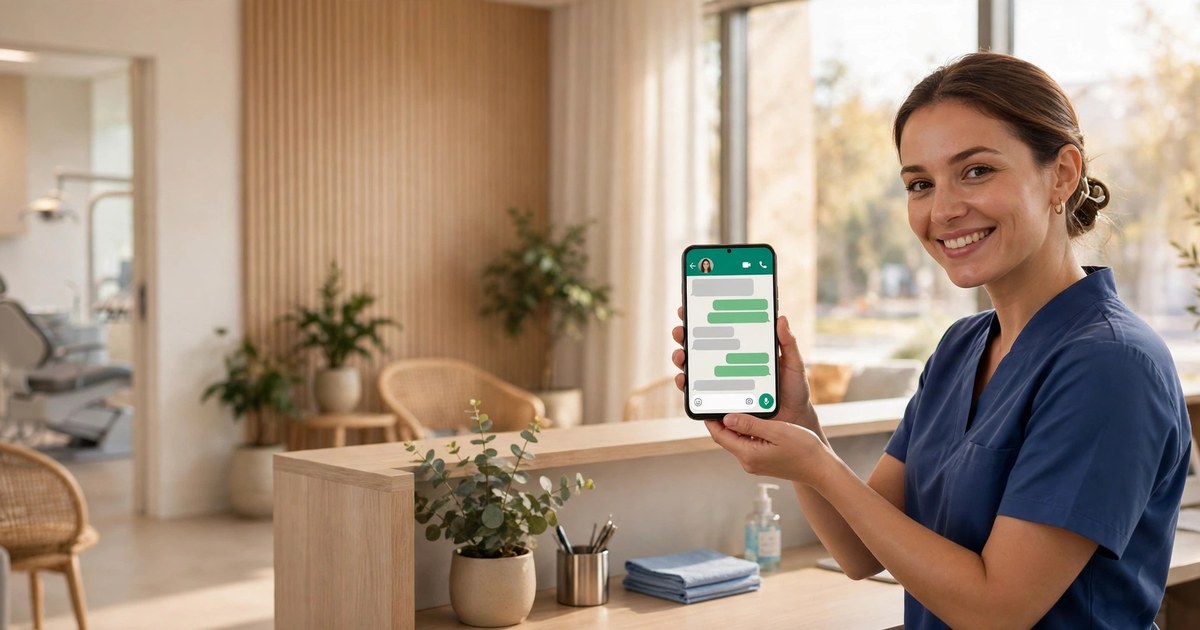
WhatsApp automation for a dental practice means an assistant that answers patient messages in seconds, confirms appointments, sends reminders, and refills a cancelled slot from the waitlist, while a clinician always handles pain, swelling, or trauma. It saves booked chair time that phone tag quietly loses.
Picture a Tuesday morning in a small UK practice. The dentist is mid-filling, the hygienist is with a patient who arrived early, and the receptionist is checking someone in while the phone rings. Four calls come before lunch. Two callers leave no message. One books with the practice down the road by two o'clock, because somebody there picked up. The practice was busy doing dentistry, and the phone does not wait for dentistry to finish.
That is the problem this guide solves. A website widget waits for a visitor who is already browsing; WhatsApp meets the patient where they already live. When a patient cannot get through on the phone, they message, and if nobody answers, they move on.
ReplyPilot builds AI chat agents for local businesses that answer customer messages on WhatsApp, Instagram and the web. For a dental practice, that means an assistant handling appointment admin and handing everything clinical to a person at once.
For the wider picture, start with the best WhatsApp automation tools guide, which compares the main approaches side by side. The pressure washing guide and the accounting firms guide show the same pattern in other trades. This article stays on one practice.
Why a missed call at a dental practice costs more than a missed call elsewhere
A missed call at a shop costs a sale. A missed call at a dental practice costs a chair. A hygienist hour cannot be remade later in the week, and a dentist hour spent waiting for a patient who forgot is an hour the practice still pays for, with a hole in the diary nobody can fill at short notice unless someone is watching the waitlist.
There is a quieter cost too. Patients judge a practice by how easy it is to reach. A patient who rings twice and gets voicemail twice thinks, "I cannot get an appointment here." An existing patient will ring a third time. A new patient who has just moved to the area will not; they will ring the next practice on the list, and your practice will never know, because a lost new patient leaves no record at all.
That is why the first job of WhatsApp automation here is simply being reachable. A patient who messages at 11:20, while the dentist is in surgery, should get a sensible reply at 11:20, not at 1 p.m. when reception finally gets a break. The reply needs to prove three things: this is the right practice, somebody has understood the reason for the message, and a next step is already happening.
What does WhatsApp automation actually do in a dental practice?
WhatsApp automation is a set of message flows, run by an assistant, that handle the admin around dental appointments: answering common questions, confirming bookings, sending reminders, collecting forms before arrival, following up a treatment plan, and offering a cancelled slot to the waitlist. It is not a dentist in a chat window. It never diagnoses, never comments on a symptom, and never says anything about a photo of teeth or gums. That line is the whole design: everything on one side can be automated, everything on the other goes to a clinician, fast, with the thread attached.
Patients message about a short list of things, repeated weekly: new-patient questions, check-up prices, moving or cancelling appointments, lost fillings, loose crowns, nerves about Friday, parking. An assistant can answer the admin half from the practice's own words: opening hours, directions, parking, what a first appointment includes, and how cancellations work.
The key distinction is between answering and deciding. The assistant answers from information the practice wrote. It does not invent a fee, a waiting time, or an availability that nobody confirmed. This matters in a UK practice because one practice often serves NHS and private patients side by side, and the answer to "how much is a check-up" can depend on the patient. One that says, "That depends on whether you are seen as an NHS or private patient, so reception will confirm your exact position here," is honest, and the patient respects it. If the practice did not write it, the assistant does not say it.
This article is about WhatsApp threads, not website chat widgets: the thread is personal, stays on the patient's phone, and is where reminders actually get read.
Capturing the patient who calls while the dentist is chairside
It is 10:40. The dentist is chairside fitting a crown. The phone rings in reception. The receptionist is settling a bill and cannot reach it before it stops. The caller leaves no voicemail, because most people no longer do. They send a WhatsApp message instead, if the practice number is set up to receive one.
The missed-call flow is simple and valuable: when a call goes unanswered, the patient gets a WhatsApp message within a few minutes:
"Hello, this is the reception team at the practice. We missed your call just now because we are with patients. Are you booking a check-up, moving an appointment, or is something urgent with a tooth? Reply with one word and we will take it from here."
That message tells the patient they were noticed, sorts the reason for the call into a lane the practice can act on, and keeps the patient in a thread the practice controls. "Booking" gets the booking flow, "moving" gets the reschedule flow, and anything about pain, swelling, a broken tooth, or trauma skips every flow and goes straight to a person, flagged as urgent.
Each lane has its own limit. A booking enquiry gets the practice's first-appointment wording, the new-or-existing question, and a small number of real slots, never one the diary does not hold. A reschedule request gets the current appointment restated back, then the alternative times. A cancellation gets a thank you and a confirmation that the slot is freed.
After-hours messages need care. A patient who messages at 10 p.m. about a tooth keeping them awake is not routine, however polite the message. The assistant should acknowledge it at once, say the practice is closed, give the practice's own out-of-hours arrangement, and flag the thread first for the morning. It must never ask about the symptom or suggest a home remedy.
How does the reminder cadence work for check-ups and hygienist visits?
Most practices send the same reminder for every kind of appointment. A check-up, a hygienist visit, and a treatment visit are not the same conversation.
A check-up reminder is a diary-keeping message. The patient booked it months ago, and the reminder asks one question: is this still in your diary? One message two or three days before, and one short message on the morning, is enough. The first carries the date, the time, and two actions: confirm, or move it. A third message in between trains patients to ignore the practice.
A hygienist visit reminder is a preparation message as much as a diary message. The patient needs to know it is a hygienist visit, not a check-up with the dentist, because patients mix the two up constantly. Name the visit plainly, say how long to allow, and mention anything to bring or do beforehand. That clarification alone prevents wrong-clinician arrivals and quiet no-shows.
A treatment visit reminder is different again. The patient may be nervous and tempted to cancel without saying why. State what the visit is for in plain words, how long it will take, and invite questions: "If anything about Friday's visit is worrying you, reply here and reception will ask the dentist to call you."
The rule underneath all three: every reminder must let the patient act inside the message — confirm, move, or cancel, right there in the thread. A reminder saying "please call us to confirm" throws away WhatsApp's whole advantage, and a cancellation two days out is a gift, because two days is enough time to refill the slot.
The reminder habit has published evidence behind it, from a large count rather than a vendor's sales page. A Sesame Communications five-year panel of 1,604,184 appointments across 64 dental practices found that automated reminders reduced no-shows by 22.95%, as reported by Denzif in its WhatsApp reminder guide. The Spanish dental network Vitaldent, with 390 clinics, replaced SMS with WhatsApp utility messages for scheduling between August 2024 and February 2025, also as reported by Denzif. Neither figure promises your practice the same result.
What should a treatment-plan follow-up say, and what should it never do?
Your customers are already on WhatsApp
ReplyPilot turns your business WhatsApp into an always-on front desk — instant answers, real bookings in your calendar, and a clean handoff to you the moment a conversation needs a person.
Ask on WhatsApp — it's freeA treatment plan is the hardest message a practice sends: the patient most needs time to think, and the practice most wants an answer. The dentist explained the plan in the surgery. The patient nodded, went home, talked to a partner, looked at the cost, and did nothing. Three weeks later the plan is still open, and reception is unsure whether chasing would be helpful or pushy. Most practices solve this by not chasing at all, which is also a decision, and a costly one.
The follow-up that works is short, factual, and stops after one message: it restates the plan in plain words, names the next step, and offers a way to ask questions:
"Hello, this is the practice following up on the treatment plan Dr Patel discussed with you at your visit on 12 May: a crown on the upper left molar, over two visits. The next step is to book the first visit. If you would like to talk it through, or if the timing or cost is a worry, reply here and reception will arrange a call. No need to decide in this message."
Notice what it does not do. No discount, no "limited availability," no second message three days later, no asking the patient to decide in the thread. A patient deciding about treatment for their own teeth deserves a conversation, not a countdown. One respectful follow-up keeps the door open. A drip campaign slams it.
The reason a patient has not booked is often not the reason the practice guesses: cost, fear, childcare, shift work, or a partner who thinks the tooth can wait. More messages will not find out which one. A short call from reception, arranged through the thread, can. So the follow-up's real job is to earn the call, passing the thread to reception with the plan attached.
For comparison, the ChatDaddy guide for dentists covers treatment-plan follow-ups alongside reminders and recall, from a platform point of view. The difference here is the rule: one message, no pressure, and a human conversation for the decision.
How do you refill a failed appointment from the waitlist?
A failed appointment is a slot that opened too late for the normal diary to fill. The patient cancelled this morning, or simply did not come, and now a hygienist hour at 2 p.m. stands empty. Every practice has a mental list of patients who wanted an earlier slot, but almost none has a system for reaching them fast enough. By the time reception has rung three people, the slot is gone.
The waitlist flow fixes this by being fast and specific: the moment a slot opens, the assistant messages one patient at a time, not the whole list at once:
"Hello, a hygienist appointment has opened up tomorrow, Wednesday, at 2 p.m. Would you like it? Reply YES and we will book it for you, or NO and we will offer it to the next patient. No need to call."
One patient, one slot, one answer. If the patient says yes, the slot is booked and nobody else is messaged about it. If they say no, or do not reply within a window the practice sets in advance, the assistant moves to the next patient. Messaging five patients about one slot feels like a race, and the four who lose feel tricked. Messaging one at a time feels like being remembered.
Two manners here are easy to miss. The patient who says no should get a gracious reply and stay on the waitlist. The patient who never replied should not be punished either: a missed message is not a refusal. Treat the waitlist as people who want help sooner, not a test of who replies fastest.
The patient who failed the appointment deserves a kind message the same day: "We missed you today. Is everything all right? Reply here to rebook." No scolding, no charge threat, no lecture. Some patients missed because life happened; some because they were scared. A kind message finds out which one.
New patients: forms, directions and what to leave out
A new patient's first visit is won or lost before they arrive. If they arrive with forms unfinished, unsure where to park, and unclear how long the visit will take, the appointment starts late and reception starts stressed. A WhatsApp pre-arrival pack, sent when the first appointment is booked, prevents almost all of that.
The pack has four parts, and only four. First, the appointment restated: date, time, clinician type, and how long to allow. Second, directions and parking, in the practice's own words, including anything a satnav gets wrong. Third, what to bring: current medicines if asked for, and any exemption or payment details the practice needs. Fourth, the forms: a link to the new-patient form, to complete before arrival, with a note that reception can help in person if it is difficult. Anything longer is a brochure, and patients do not read brochures on their phones.
What to leave out matters just as much. No medical history questions in chat, no asking a new patient to describe a problem in WhatsApp before arrival, no long list of treatments and prices nobody asked about. The pack is admin, and admin is what WhatsApp is good at. The clinical conversation happens in the surgery. Keeping that boundary protects patient and practice alike.
The website is a second front door with its own habits. The website chatbot article for dental clinics covers that channel separately; a patient who starts on one channel and continues on the other should never have to repeat themselves.
How do you reassure an anxious patient without giving clinical advice?
Dental anxiety is the reason a large share of failed appointments happen, and why some treatment plans sit unbooked for months. An anxious patient rarely says "I am anxious." They say "Can I move Friday?" and then move it again. Or they say nothing, and simply do not come. WhatsApp gives them a private way to say they are scared, without saying it out loud in a waiting room.
The reassurance flow starts before the visit. After a treatment visit is booked, the patient gets a short message naming what will happen in plain words, how long it will take, and a private way to ask for help:
"Hello, ahead of your visit on Friday, here is what to expect. You will see Dr Patel for the filling on the upper right tooth. Please allow about 40 minutes. If you feel nervous about dental visits, you are not alone, and you can reply here privately. Reception can arrange a short call with the dentist beforehand, or note that you would like extra breaks during the visit."
That message does not ask about symptoms, and does not promise a pain-free visit. It offers practical control: a call beforehand, breaks during the visit, and a private channel to ask. A real option attached to reassurance is a reason to turn up.
On the day, the flow stays practical: a short morning message, the time, and a reminder that the patient can reply to move the visit rather than simply not coming. If they move it, the reply is kind and rebooking is offered at once. If they arrive, reception already knows they asked for extra breaks.
Here is the opinion that belongs only to dental practices. In most trades, automation aims to keep the customer in the chat as long as possible. For an anxious dental patient, the aim is the opposite: get them out of the chat and into a human conversation as fast as possible. They do not need a better bot. They need a person who knows their name, has read their thread, and will be there on Friday. Judge every message in this flow by one question: does it make that human conversation more likely, or replace it? If it replaces it, delete it.
What must never be automated, and what does a two-week setup look like?
Some things must never be automated, and the list should be taught to every new member of staff. The assistant never diagnoses, never comments on a symptom, swelling, pain, or photo of teeth or gums, never gives treatment advice, never says whether something can wait, and never reassures a patient that a symptom sounds fine. It never handles a complaint alone, never shares clinical detail in chat, and never decides who is urgent. It flags urgency and hands it to a clinician. Flagging is admin. Deciding is clinical.
The CodeWords guide to WhatsApp automation for dental practices makes the same point: never automate clinical advice, triage, results, complaints or safeguarding, and name one channel owner, usually the practice manager. Borrow its staging: reachable first, then reminders, then diary-moving flows, then intake and recall.
A sensible build takes about a fortnight, and most of that time goes on writing replies in the practice's own voice, not on wiring software. Week one covers the conversation: the missed-call reply, booking reply, three reminder types, treatment-plan follow-up, waitlist message, and pre-arrival pack, each tested against real old messages. Week two covers the diary and the handover: genuine slots, messages that go straight to a person, and who looks after the channel. The golden rule: when unsure, the assistant admits it and passes the thread to a person with a short summary, instead of guessing.
One practical WhatsApp rule belongs here. A business may reply freely for a day after the patient's last message; after that, only approved templates may go out. Prepare those templates ahead of time, and only message patients who have agreed to WhatsApp contact.
For practices that would rather have the build done for them, the build is $249: $125 to begin and $124 when it goes live, and the Care Plan is $99 a month for upkeep and changes. A practice that builds its own version from this guide has the complete method at no cost.
Frequently asked questions
Can WhatsApp automation diagnose a tooth problem from a photo?
No, and it must never try. A photo of teeth or gums goes to a clinician with no comment from the assistant, and pain, swelling or trauma is flagged for a person at once. Clinical questions always leave the chat for a clinician.
Do patients realise they are talking to an assistant?
Say so upfront, in the first message. Most patients accept a fast assistant that passes them cleanly to a person; what breaks trust is feeling tricked.
What happens when a patient cancels from a reminder?
The cancellation is confirmed in the thread, the slot is freed, and the waitlist flow offers it to one patient at a time, starting with the longest-waiting patient for that kind of appointment. Nobody is asked to ring back.
Does this work for a practice with both NHS and private patients?
Yes, as long as the assistant uses only the practice's own words for availability and charges and never guesses the patient's category. Where the answer depends on the patient, it says so and passes the question to reception.
How soon will the assistant sound like our practice?
About a fortnight, if the build is tested against real old messages: vague, nervous, cost, and 10 p.m. arrivals. If it handles those in the practice's voice, it is ready. If it only copes with easy messages, it needs more writing first.
Begin with a single change. Answer every missed call with a WhatsApp message within minutes, sort the reply into booking, reschedule or urgent, and hand anything clinical to a person at once. Add the reminders next, then the waitlist refill, then the treatment-plan follow-up.
Your specific next step from this article is to try the free custom demo on the ReplyPilot site, and watch an assistant answer a dental enquiry from a missed call to a confirmed appointment.