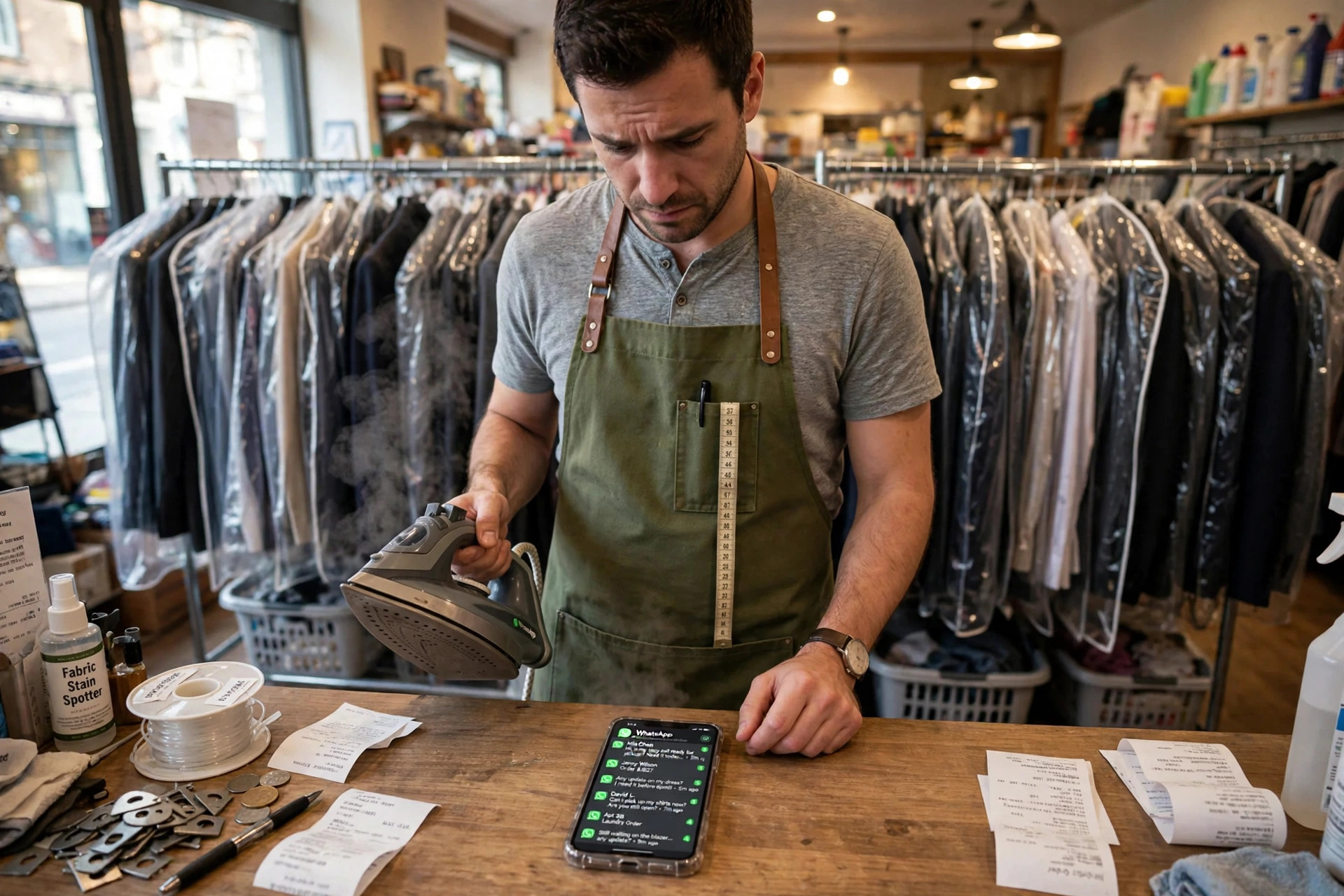
Tuesday, 6pm. You are at the press, finishing a suit someone needs tomorrow morning. Your phone has been buzzing for an hour. 'Can you pick up on Thursday?' 'Is my blue shirt ready?' 'Do you do leather jackets?' 'Can I pay online?' Seven customers, seven small questions, and every one of them is standing between you and finishing the work in front of you. You will answer at 9pm from your sofa, typing with tired thumbs, and one of those customers will have already tried the cleaner down the street. WhatsApp automation for dry cleaners means an AI assistant that answers those messages the second they arrive. It books pickups, tells customers their order status, sends payment links, and brings quiet customers back with gentle reminders. For a dry cleaner, the best approach is chat-based automation because your customers' questions are small, urgent and repetitive - pickup times, ready dates, prices - and a reply that arrives in seconds keeps the customer while a reply that arrives tonight loses them to the shop with the faster phone.
Why Your Counter Phone Is the Busiest Employee You Never Hired
Walk into any dry cleaner and watch the phone. It rings during pressing, it rings during tagging, it rings when the owner is carrying a full rack. Every call is the same handful of questions, and every call stops real work. The dry-cleaning business runs on trust and routine, which makes it perfect for automation: the questions repeat daily, the answers are factual, and customers care about speed more than small talk.
There is a quieter cost too. When customers cannot reach you, they do not wait patiently - they assume you are closed, busy, or not interested. The cleaner who answers instantly looks professional. The cleaner who answers at night looks overwhelmed. Your customers cannot see your good work; they can only see your response time. A customer who calls twice with no answer has already found another cleaner.
What WhatsApp Automation for Dry Cleaners Actually Does
Think of it as the perfect counter assistant - one who knows every order, never forgets a pickup, and answers at 2am without complaint. It lives on your existing WhatsApp number, so customers do not download anything or learn anything new. They message you the way they already do, and the answers come back instantly.
- Books pickups in the chat - collects the address, preferred day and bag count, and confirms the slot.
- Answers 'is my order ready?' instantly by looking up the order status you keep in your book or system.
- Sends 'ready for collection' messages the moment an order is tagged and finished.
- Shares payment links so customers can pay before they arrive - or from their sofa.
- Reminds regulars who have not dropped off in weeks, with a friendly nudge and a pickup offer.
- Hands over to you with the full chat history when something unusual comes up.
The pattern is simple: routine questions get instant answers, and you get your hands back for the pressing, spotting and finishing that actually earns the money. The assistant handles the phone; you handle the garments.
How Can a Dry Cleaner Take Pickup Bookings on WhatsApp?
The old way: a customer calls, you scribble the address on a receipt while the press hisses, and you hope you read your own handwriting later. The new way: the customer messages 'pickup please', the assistant asks for the address if it is new, offers the next pickup windows - 'Thursday between 9 and 12, or Friday afternoon' - and confirms with a summary she can check. The booking lands in your pickup list with everything spelled correctly.
The detail that makes it work is the confirmation message. 'Pickup confirmed: Thursday 9-12, 14 Oak Road, 2 bags. Driver will ring twice.' The customer feels looked after, and you have a written record instead of a memory. Disputed pickups - 'you never came' versus 'nobody answered' - drop sharply when both sides can scroll back and read what was agreed, which also ends the awkward 'who is right' argument for good.
For shops that run a delivery route, the assistant can group pickups by area and remind you each morning which streets are on today's run. It becomes your dispatcher as well as your receptionist. Owners who deliver say this alone saves an hour of morning phone chaos.
What Should the Chatbot Do When a Customer Asks 'Is My Order Ready?'
This is the single most common dry-cleaning message, and it deserves a perfect answer every time. The assistant checks your order book or simple status sheet and replies with the truth: 'Your 3 shirts are pressed and ready - collect any time before 7pm today.' No guessing, no 'let me check and call you back', no silence. Status questions have exactly one good answer: the current status, instantly.
The honest edge cases matter. If the order is delayed, the assistant says so before the customer asks: 'Your suit needs one more day - the stain treatment took longer than usual. It will be ready Friday morning, and we are sorry for the wait.' Customers forgive delays they are told about. They do not forgive delays they discover at your counter.
This only works if your status records are real. You do not need fancy software - a shared sheet with order numbers and simple statuses (received, in process, ready) is enough. The assistant reads it; you update it as you work. Ten seconds of updating per order buys you zero 'is it ready?' calls.
Payment Links in Chat: Getting Paid Without the Counter Dance
Every dry cleaner knows the counter dance: the customer arrives in a rush, the card machine needs a moment, someone is waiting behind them. Payment links skip the whole scene. When the order is ready, the assistant sends the total with a secure payment link. The customer pays from home, collects with a quick 'paid, thanks', and the queue never forms.
The second win is overdue payments. Chasing money is the conversation every owner hates, so it often never happens - and the unpaid bag sits on the rack for a month. A polite automated reminder - 'Just a reminder: order 1142 is ready and the balance is payable here' - collects money you were quietly writing off. It is firm without being awkward, because it is not you saying it.
Winning Back the Customers Who Quietly Stopped Coming
Dry cleaning is a habit business. Customers do not usually leave in anger; they drift. A new job with different hours, a move across town, a month of wearing casual clothes. Then the habit is gone. A gentle message after a few quiet weeks brings many of them back: 'We have missed you - your usual shirts are welcome any time, and we can pick up Thursday if that helps.'
The key word is gentle. One warm message with a real reason to return - a free pickup offer, a seasonal reminder before wedding season - works far better than a discount blast. And the assistant knows who to message: only past customers who agreed to hear from you, never cold numbers. ReplyPilot (AI automation for small-business messaging - WhatsApp, Instagram DM, website chat) keeps those opt-in lists clean so your win-back messages feel welcome instead of spammy.
Watch what happens after two or three cycles of this. Your quiet customers start reappearing at the counter, bags in hand, saying 'you reminded me at just the right time.' That is the habit business working the way it should.
Stain Emergencies, Same-Day Promises, and Honest Answers
'I spilled red wine on a white shirt an hour ago - can you save it?' This is the dry-cleaning equivalent of a hospital emergency, and it arrives by WhatsApp at the worst possible moment. The assistant's job is not to promise a miracle. Its job is to give honest first aid ('blot, do not rub, keep it damp, bring it in today') and book the drop-off immediately.
Same-day and express service questions need the same honesty. If your express cutoff is 10am, the assistant says so plainly and offers the next available express slot. Over-promising a same-day turnaround you cannot deliver is how five-star shops earn one-star reviews. Under-promise in the chat; over-deliver at the counter.
The Pickup-and-Delivery Route: Turning WhatsApp Into Your Dispatcher
If you collect and deliver, your WhatsApp is already your dispatch office - just a messy one. The assistant turns it into a tidy one. It confirms each pickup with a time window, messages the customer when the driver is nearby, and confirms delivery with a summary. Three messages, zero phone calls, and the driver never stands at a door wondering if this is the right house.
Want this for your dry cleaners?
ReplyPilot builds a custom whatsapp automation setup for your dry cleaners — answering customer questions instantly, taking orders and bookings, and handing off to you when a human is needed.
Ask on WhatsApp — it's freeThe 'driver is nearby' message is small but powerful. It cuts failed pickups dramatically, because the customer is at the door when the van arrives. Failed pickups are pure cost - fuel, wages, time - with zero revenue. One automated message per stop pays for itself in diesel alone.
How Do You Answer 'Do You Do Leather, Fur, or Wedding Dresses?'
Specialty garments are where dry cleaners either earn a premium or earn a disaster. 'Do you clean leather jackets?' 'Can you handle my wedding dress?' 'What about a Persian rug?' These questions need confident, accurate answers - and they arrive when you are elbow-deep in someone else's laundry. The assistant answers from your real capabilities list: what you clean in-house, what you send to a specialist, what you do not touch, and the honest timelines and prices for each.
The wedding-dress question deserves special care, because it is a once-in-a-lifetime garment with a once-in-a-lifetime price tag. The assistant explains your preservation process in plain words - inspection, hand treatment, boxed storage - and books a consultation slot rather than quoting blind. Brides trust shops that slow down for the important pieces. That instinct can be automated; the care behind it cannot be faked, so the answers must be yours.
For items you send out to specialists, the assistant sets the expectation honestly: 'We send leather to our specialist partner - it takes about ten days and we will keep you updated at each step.' Customers respect transparency far more than they respect speed. A shop that says what it does not do is a shop customers believe when it says what it does.
Seasonal Rhythms: Why Your WhatsApp Should Think in Seasons
Dry cleaning has seasons, and each one brings a wave of the same messages. Spring brings wedding outfits and suit refreshes. Summer brings holiday wardrobes. Autumn brings coat season - the single busiest fortnight of the year for many cleaners. Winter brings party dresses and heavy overcoats. An assistant that knows the season can greet it properly: 'Coat season is here - send us your winter coats this week and beat the rush.'
These seasonal messages are the highest-performing broadcasts a dry cleaner can send, because they arrive exactly when the customer is thinking about it. The assistant sends them to opted-in past customers, handles the flood of replies, and books the pickups - all in the same week you are already at full stretch. Without automation, the busiest weeks are precisely when your phone goes unanswered. With it, the busy season becomes the profitable season.
When Automation Must Hand Over to a Human
Garments carry emotions - a wedding dress, a late father's suit, a favourite coat. When a customer is upset about damage or a lost item, no machine should handle it. Your handoff rules should name these moments plainly: damage complaints, lost items, anything involving tears or anger, and any request the assistant cannot answer from your real records.
The handoff itself should feel like good service. The assistant says, 'Let me get the owner - he knows your order personally. One moment.' You receive the whole conversation, so you know exactly what happened before you speak. A customer who feels heard in the first ten seconds of your reply is already halfway to forgiving the problem.
Mistakes That Ruin Dry-Cleaning Automations
- Guessing order status instead of reading the real records - one wrong 'it is ready' destroys trust for a year.
- Sending payment links for the wrong amount - double-check that totals come from your book, not from memory.
- Broadcasting offers to cold numbers - win-back messages only ever go to past customers who opted in.
- Letting the assistant promise express turnarounds you cannot keep - the chat should under-promise, always.
- Skipping the handoff rules - an upset customer arguing with a machine is a lost customer.
- Forgetting regulars' names and habits - the assistant should greet repeat customers like the regulars they are.
Manual Replies vs Counter Software vs Automation: A Simple Comparison
Speed of reply | You, mid-press: hours | Counter software alone: still needs you to type | Automation: seconds, day and night\nOrder-status answers | You: from memory, sometimes wrong | Software: accurate if you open it | Automation: accurate and instant, reads the same records\nPickup booking | You: scribbled on paper | Software: manual entry | Automation: booked, confirmed and listed automatically\nWin-back of quiet customers | You: when you remember | Software: not its job | Automation: scheduled gently, every cycle\nCost pattern | You: your evenings | Software: monthly plan, still needs your time | Automation: monthly plan plus per-message fees, no extra staff time
Counter software organises your records; automation organises your conversations. Most dry cleaners benefit from both, but if you pick one first, pick the one that answers the customer - because unanswered customers are the ones you lose.
Your First 30 Days: Getting This Live Between Loads
Step 1: Write your dry-cleaning shop's real answers. List your ten most-asked questions with the true answers - pickup days, express cutoff, price list, fabric limits. This becomes the assistant's brain.\nStep 2: Set up a simple status sheet. Order number, customer name, status: received, in process, ready. Update it as you tag and finish.\nStep 3: Connect your pickup calendar. Give the assistant your real pickup windows so every booking it makes is one you can keep.\nStep 4: Run a quiet week. Let it answer new messages while you watch the chats and fix anything that sounds off.\nStep 5: Switch on reminders and win-backs. Once daily replies feel right, add the ready-for-collection messages and the gentle nudges to quiet customers.
Start with answers and pickups; add the clever stuff later. A dry cleaner that automates one thing well beats one that automates five things badly.
Measuring What Matters for Your Dry Cleaners (Beyond 'Messages Answered')
Four numbers tell you the truth. Repeat orders per month - the habit business lives here. Pickup bookings from WhatsApp - your new revenue channel. Average reply time - it should sit under a minute. Unpaid balances over 30 days - they should shrink as reminders go out.
A 95% open rate with flat repeat orders is a vanity metric. Check your shop's four numbers monthly. If repeat orders climb and unpaid balances fall, the system is earning its keep. The same habit logic powers neighbouring services - see how laundry services and car wash bookings run on the same repeat-visit engine.
Staying Ban-Proof for Dry Cleaners: The Rules That Matter
Your WhatsApp number is a business asset - protect it like one. Only message people who contacted your dry cleaners first or opted in. Win-back and offer messages go to past customers with consent, never to cold lists. Meta's Business Platform documentation lays out the consent and template rules every dry-cleaning setup must follow.
The practical version for a dry cleaner: never buy phone lists, never blast the neighbourhood, and always include a simple way to stop receiving messages. A customer who opts out politely may still bring you shirts. A customer who reports you will not - and a flagged number is a nightmare to recover. For the technical setup steps, the WhatsApp Business API setup guide walks through the official route.
What It Costs to Run
The cost has two parts: the automation platform's monthly plan and WhatsApp's per-message fees for business-initiated conversations. Replies inside an open customer conversation cost less than starting new ones, so an assistant that answers fully the first time is also the cheapest kind. And timing matters right now - WhatsApp Business changed its pricing in October 2026, so every dry cleaner should be looking at which messages they actually need to send. An assistant that confirms a pickup in one message instead of four phone calls is exactly the kind of efficiency this moment rewards.
Do the honest maths: if the reminders collect two forgotten balances a month and the win-backs bring back three quiet regulars, the system has paid for itself many times over. The alternative is not free - it is your evenings, your missed calls, and the customers who quietly stopped coming.
Ready to stop choosing between the press and the phone? Request a free custom demo at https://replypilot-site.vercel.app/ and watch your own most-asked questions answered live. ReplyPilot builds the assistant around your real pickup days, your price list and your tone - so the messages sound like you on your best day, every day.
Frequently Asked Questions
How does WhatsApp automation know if my customer's order is ready?
It reads the order records you already keep - a simple sheet with order numbers and statuses like received, in process, or ready works perfectly. When a customer asks, it checks the sheet and answers instantly. The only discipline it needs from you is updating the status as you tag and finish each order.
Can it take pickup bookings without me answering the phone?
Yes. It collects the address, offers your real pickup windows, and confirms the booking with a written summary the customer can check. The booking goes straight into your pickup list, and the 'driver is nearby' message goes out automatically on the day.
What if a customer is angry about a damaged garment?
The assistant hands over to you immediately with the full conversation attached. Damage complaints, lost items and upset customers are human-only territory by design. You pick up the chat knowing exactly what happened, which is how a bad moment becomes a recovered customer.
Is it safe to send payment links over WhatsApp?
Yes, when the links come from a proper payment provider and the totals come from your own order records. Customers pay from their phone and collect without queueing. The assistant never invents amounts - every figure is pulled from your book, which keeps the money side trustworthy.
Will this work if I am not technical at all?
Yes. The setup is built around your answers, your price list and your pickup days - no coding on your side. You write what you would say to a customer, and the assistant learns to say it the same way. Most owners are comfortable with the system within the first quiet week.
How long before I see results?
Reply speed changes on day one. The bigger wins - more pickups booked, fewer unpaid balances, quiet regulars returning - typically show within the first month once reminders and win-back messages are running. Check your repeat-order numbers after 30 days and the trend will be visible.