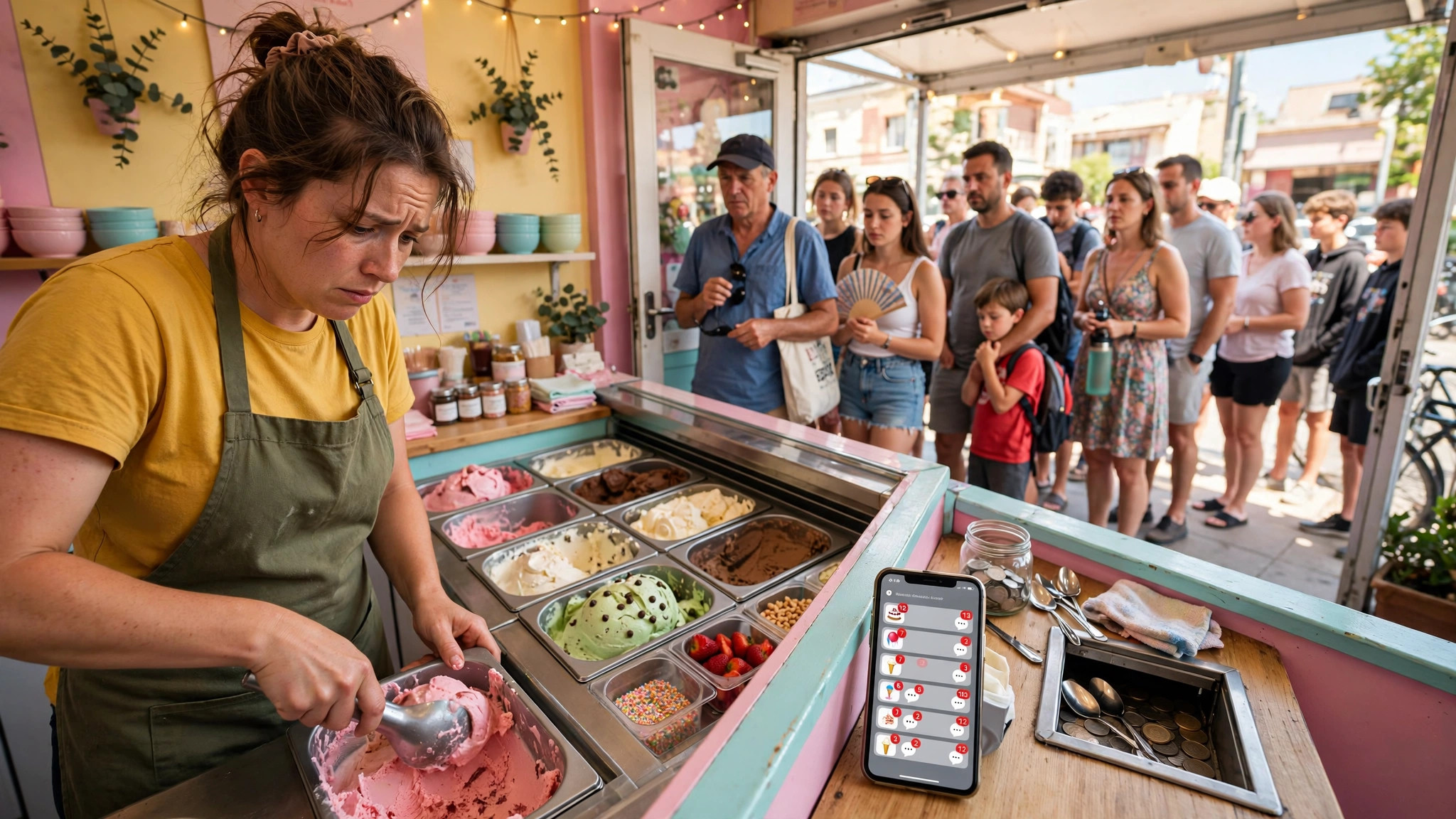
It is a warm summer evening, and your parlor is full. Kids press against the glass, pointing at tubs. A dad holds a cone in each hand while his little one changes her mind for the third time. Behind the counter, your scooper works as fast as she can, and the line still stretches to the door. On the shelf by the till, your phone keeps buzzing. "Do you have pistachio today?" "Can I order six tubs for tomorrow?" "Do you do birthday parties?" "Are you open late tonight?" Nobody can pick up that phone. Every hand is busy scooping, taking payment, or wiping a sticky counter. By closing time, half those messages are still unread. The pistachio fan has walked to another parlor. The bulk order went somewhere else. The mum planning a birthday party picked the place that answered first. WhatsApp automation for ice cream parlors exists for exactly this evening. It answers the phone queue while your team serves the real queue, so a busy night stops costing you orders you never even saw.
Quick answer: WhatsApp automation for ice cream parlors is an automated assistant on your parlor's WhatsApp number that answers flavour, stock, opening-hour and party questions in seconds. It takes takeaway and bulk orders, collects party booking details such as date, headcount and cake choice, and hands allergy and food-safety questions to a staff member. Your team keeps scooping while no message waits.
ReplyPilot (AI automation for small-business messaging — WhatsApp, Instagram DM, website chat) is built for shops like yours: small teams, busy peaks, and customers who message instead of calling. This guide is the parlor playbook. It covers what the automation should answer, what it must never guess, how party bookings and bulk orders work in chat, and how to set it up without turning your parlor into a call centre. Read it as an owner, not as a tech person. Every step here is written for someone whose real job is scooping ice cream, not staring at a screen.
Why do parlor messages peak exactly when your staff are busiest?
Ice cream is a weather business and a mood business. People do not plan an ice cream visit a week ahead. They feel hot, they finish dinner, they walk past your door, and they want a cone now. That is why your busiest hour is also your messiest hour for messages. The same warm evening that fills your shop also fills your phone. Families message from the car on the way over. Friends message from a restaurant nearby, asking if you are still open. A mum messages while her kids argue about flavours in the back seat. Your staff are busiest at the exact moment your customers most want a quick answer.
The second peak is quieter but just as costly. It comes late at night, after you have closed. A parent sits on the sofa planning a birthday party and messages three parlors at once. A teacher plans a school treat and asks about a bulk order for a class trip. An office worker orders tubs for a Friday treat. These messages arrive when nobody is at the counter. The parlor that answers first in the morning usually wins the booking, because the parent has moved on to cakes, decorations, and invitations by lunchtime. A slow reply here is not a small delay. It is a lost party.
There is a third pattern owners often miss: the question that stops a visit before it starts. "Do you have mango today?" sounds like a small question, but for the family driving across town, it decides the trip. If they get no answer, they stay home or pick a nearer shop. If they get an instant answer — yes, mango is in today, and here are the sizes — they come. The same is true for "are you open late?" and "do you have sugar-free options?" These are not chats. They are the last step before a sale. An ice cream parlor WhatsApp chatbot answers that step in seconds, at any hour, while your team stays focused on the people already at the counter.
What should your automation answer — and what must it hand to a person?
Start with the questions your phone already gets every day. Today's flavours and what is sold out. Sizes, from a single scoop to a family tub. Toppings and extras. Opening hours, including late summer hours. Your address and parking notes. Whether you take card payment. Whether you deliver nearby or offer pickup only. These answers are facts from your own menu and your own day. Put them in the automation once, update them when a tub runs out, and every customer gets the same correct answer, instantly. That alone clears most of your message queue, and it frees your staff to scoop instead of repeating the same answers all evening.
WhatsApp automation for ice cream parlors works best when it is honest about stock. A customer who is told a flavour is ready, then arrives to find it gone, feels tricked. A customer who is told it sold out, and offered a close second choice, feels looked after. So the automation must follow your real stock, not a fixed menu from last month. When pistachio runs out at eight in the evening, the answer changes at eight in the evening. When a new tub goes in the freezer, the answer changes too. It never invents a flavour as in stock. Owners who update stock once a day, before the evening rush, avoid most of the awkward counter moments. The habit takes a few minutes and saves far more in saved trips and saved tempers.
Then there is the line the automation must never cross: allergy and ingredient questions. A chatbot must never guess about ingredients. If a customer asks whether a flavour contains nuts, milk, eggs, gluten, or anything else that could harm them, the automation must not invent an answer from a flavour name. It must give the safe reply every time: it passes the question straight to a staff member, and it tells the customer a person will confirm. The same rule covers food-safety questions, like how long a tub keeps. Those questions always go to a human. A parlor that is careful with allergy questions earns trust no advert can buy, especially from parents of children with allergies, who remember the shops that took their question seriously.
How do takeaway and bulk orders work in WhatsApp chat?
Takeaway orders are the simplest win, and the one most parlors get wrong by doing them by voice call. A customer calls, the counter is noisy, the order gets misheard, and the tubs are wrong. In chat, the order is written down. The customer picks flavours, sizes, and toppings step by step. The automation repeats the order back for confirmation. The customer gets a pickup time. Your team sees a clear list, in order, with no shouting over the freezer hum. When the customer arrives, the order is packed and waiting. The counter stays a pickup point, not a bottleneck. This is the same order-ahead logic that works for busy drink shops, and our guide to WhatsApp automation for juice bars shows how that flow runs when the queue never stops.
Bulk orders need a little more care, because they are bigger and the customer is more nervous. Someone ordering tubs for a family gathering, a school event, or an office party wants to know the order is really in hand. The automation should collect the details one at a time: which flavours, how many tubs, what size, when it is needed, and who is picking it up. It should confirm the full list before the customer commits, and send a reminder the day before pickup. If the customer changes a flavour, the change is written in the same chat, so nobody has to remember a phone call from three days ago. That written record protects both sides. The customer has proof of what they ordered. Your team has a clear list to pack from.
To automate ice cream orders well, keep the chat short and the choices clear. Offer the flavours you actually have that day first, not a long list that ends in disappointment. Ask one question at a time. Confirm before you finish. Give a pickup time you can keep, even on a busy night, rather than a hopeful time that slips. And always leave a way to reach a person. A customer with an unusual request — a flavour mix you have never made, a very large order, a delivery to a venue — should be able to ask for a staff member without fighting the chat. The automation handles the everyday orders. People handle the unusual ones. That split keeps both fast.
How do party and event bookings work without phone tag?
Party bookings are where parlors lose the most money to slow replies, because a party is a big order and the customer is comparing options. The parent who wants an ice cream party usually messages two or three places in one evening. The first place to give a clear, friendly answer with real details often gets the booking. An automated chat can do that first step at any hour. It asks for the date, the number of guests, the age group, and whether the customer wants a sit-down party, a takeaway cake, or tubs to serve at home. It takes a name and a phone number, then books a short call or visit with the owner to confirm the final details. The same flow covers school treats, office parties, and community events, since each one starts with the same four details: date, headcount, what is needed, and where it is going.
Your customers are already on WhatsApp
ReplyPilot turns your business WhatsApp into an always-on front desk — instant answers, real bookings in your calendar, and a clean handoff to you the moment a conversation needs a person.
Ask on WhatsApp — it's freeIce cream cakes deserve their own careful flow, because a cake order has more ways to go wrong than a cone. The automation should collect the cake flavour, the size, the message on top, the date it is needed, and the pickup time, one question at a time. It should repeat the full cake order back, including the spelling of names on the cake, before it is confirmed. A misspelled name on a birthday cake ruins the day, and a chat record makes it easy to check. If the customer wants a design you have never made, the automation hands the chat to a staff member with photos and notes, rather than promising a design the team cannot deliver. A reminder a few days before the party catches changed headcounts while there is still time to adjust.
How do seasonal flavours and quiet-day offers work without spamming people?
Every parlor has a seasonal moment: mango season, a new flavour launch, a festival special, a limited tub that will not last the week. These are the messages customers actually want, but only if they asked for them. The consent rule is simple and strict: send flavour news and offers only to people who said yes to updates. That yes can come at the counter, after a purchase, or in chat when a customer asks to hear about new flavours. Everyone else gets nothing. No bought lists, no guessed numbers, no messages to people who only asked one question last summer. The official WhatsApp Business Platform documentation sets out the messaging rules every setup must follow, including consent for marketing messages, and it is worth reading before any broadcast goes out: WhatsApp Business Platform docs.
When you do message, make it useful and rare. A new flavour launch works best as one short message with the flavour, the date it is in store, and a simple way to order or ask a question. A quiet-day offer works best when it solves a real problem: a slow weekday afternoon, tubs that need selling, a rainy week when footfall drops. One message on a quiet Tuesday afternoon can fill seats that would otherwise stay empty. Two messages a week, every week, will do the opposite. People mute chats that nag them, and a muted chat is worse than no chat at all. When a limited flavour sells out, say so in the same chat where it was announced, and offer the closest choice.
Loyalty in a parlor is simpler than in most shops, because the reward is obvious: a free scoop, a free topping, a treat on a birthday. Keep the count inside the chat the customer already uses, so they can check it any time without a card they will lose or an app they will not install. When a regular reaches a reward, the chat offers it plainly, with no fuss at the counter. The quiet power here is memory: the automation remembers the regular who always orders pistachio and the family that visits every Sunday. A gentle message to a quiet regular, saying pistachio is back this week, brings people back far better than a loud offer sent to everyone, but only when it is true, personal, and rare.
How do you set it up in a small parlor?
- List today's real answers first — write down today's flavours, sizes, toppings, hours, and pickup options, and keep that list fresh every day before the rush.
- Write the allergy hand-over before anything else — set the rule that allergy and ingredient questions always go to a staff member, with a clear alert and the customer's exact question attached.
- Build the order flow in chat order — flavour, size, toppings, pickup time, confirmation, in that order, with the full order repeated back before it is final.
- Add party bookings next — date, headcount, cake choice, name, and phone number, with a confirmation message that repeats every detail, including cake spellings.
- Turn on updates only with consent — collect a clear yes before any flavour news or offer goes out, and keep that list separate from one-time question askers.
- Test it like a customer — message your own number as a pistachio fan, a party mum, and a bulk buyer, and fix every confusing reply before a real customer sees it.
- Teach the team the hand-over — show every staff member where alerts arrive, how to answer an allergy question, and when to take over a chat from the automation.
One more setup step matters more than owners expect: tell customers the chat exists. A small sign at the counter, a line on the menu board, and a note on your social pages — "Message us on WhatsApp for today's flavours, orders, and party bookings" — is enough. Customers cannot use a chat they do not know about. Mobile food sellers face the same discovery problem, and our guide to WhatsApp automation for food trucks covers counter signs and location messages for shops that move. A parlor stays in one place, so a counter sign and a menu-board line will do most of the work, day after day.
What mistakes trip parlors up in month one?
The first mistake is a stale menu. The chat says mango is in, the freezer says otherwise, and the customer at the counter is upset before they even order. Update the flavour list daily, and check it before the evening rush, not after. The second mistake is a pickup time nobody can keep. On a quiet afternoon, an order may be ready in ten minutes. On a busy Saturday night, it may take far longer. Set pickup times from your busy-night speed, not your quiet-afternoon speed, and be honest when the queue is long. A customer who is told a true later time and gets their order on time is happy. A customer promised a fast time that slips is not.
The third mistake is letting the automation answer what it should pass on. Allergy questions, food-safety questions, and unusual requests are human work. Every time the automation guesses, the parlor takes a risk it does not need. Check the allergy hand-over in the first week by testing it yourself: ask the allergy question, watch the alert arrive, and watch a staff member answer it. If any step is slow or unclear, fix it before a real customer depends on it. The fourth mistake is messaging too much. A parlor that sends offers every few days trains customers to ignore it. One useful message, sent rarely, beats five loud ones. Keep a simple rule: if the message does not help this customer today, do not send it.
How do you know if it is working?
You do not need fancy reports. A parlor owner can measure this with a notebook and a weekly look at the chats. First, reply speed: how fast does the first answer arrive now, compared with the old days of unread messages until closing? Second, orders taken after hours: count the orders and party enquiries that arrived when the shop was closed, because those are sales that used to wait until morning, or never arrive at all. Third, party bookings kept: count the bookings that came through chat and actually happened, and note which ones changed date or headcount along the way. Those three counts tell you more than any dashboard, and you can collect them yourself without any special tool.
WhatsApp automation for ice cream parlors also shows its value in what stops happening. Fewer missed calls about flavours. Fewer customers arriving for a sold-out tub. Fewer party enquiries lost to a slow reply. Fewer bulk orders taken down wrong on a noisy phone call. Ask your team once a week: what did the chat handle that used to interrupt scooping? Their answers are your real report. If the team says the counter feels calmer on busy nights, the system is working. If they say they still answer the same questions by phone, the chat is not being advertised well enough, or its answers need fixing.
ReplyPilot offers a free custom demo, built around your own parlor's flavours, party options, and everyday questions, so you can see the chat answer as your customers would. If it feels right for your counter, you can try it on real messages. If it does not, you will still walk away with a clearer list of the questions your phone gets every day — and that list alone makes the next busy evening easier. See it at https://replypilot-site.vercel.app/.
Frequently Asked Questions
How does WhatsApp automation work for an ice cream parlor?
WhatsApp automation for ice cream parlors answers customer messages on your parlor's WhatsApp number in seconds, day and night. It shares today's flavours and stock, takes takeaway and bulk orders, collects party booking details, and sends pickup confirmations. When a question needs a person, it passes the chat to a staff member with the full conversation attached.
Can a chatbot take a birthday party booking for my parlor?
Yes, it collects the four details every party booking needs: date, headcount, party type or cake choice, and the customer's name and phone number. It repeats the full booking back for confirmation, including the spelling of names on cakes. The owner then confirms the final details, so no booking depends on a missed phone call.
What happens when a customer asks about allergies?
The automation never guesses about ingredients. It tells the customer a staff member will confirm, takes the exact question, and alerts the team at once. A staff member answers from real knowledge of that day's tubs and suppliers, and says so plainly if the answer cannot be confirmed.
Will customers get spammed with flavour messages?
No, flavour news and offers go only to people who said yes to updates. Customers who only asked one question are never added to a broadcast list. Messages stay short, useful, and rare, so customers welcome them instead of muting the chat.
Does it work after closing time?
Yes, and after hours is where it earns its keep. Party enquiries, bulk orders, and flavour questions that arrive at night get instant answers and confirmed details. The owner wakes up to a list of real orders and bookings, instead of a pile of unread messages and lost sales.