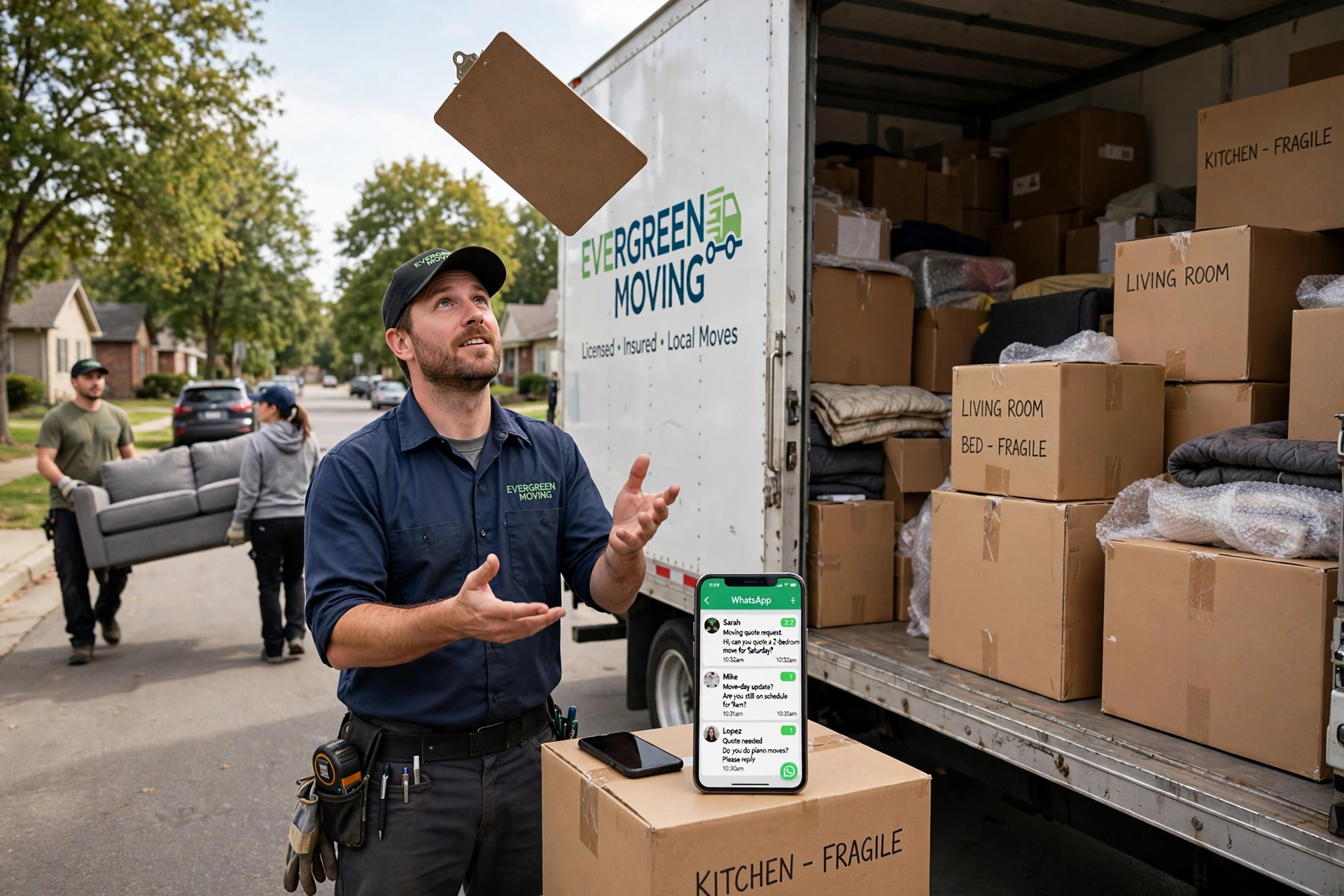
It is 8am on moving day and your crew is loading the third truck. Your phone is on top of a box marked KITCHEN - FRAGILE, buzzing every few minutes. 'Can you quote a 2-bedroom move for Saturday?' 'Are you still on schedule for 9am?' 'Do you move pianos?' 'What is your price per hour?' Four people planning the most stressful day of their year, asking you to take their money, and you are carrying a sofa. You will reply at 7pm, exhausted, and the Saturday move will already be booked with the company that answered at 8:15. WhatsApp automation for moving companies means an AI assistant that answers those messages the second they arrive. It collects move details and photos, sends quotes faster than any competitor, books the move, and keeps customers updated on move day without a single phone call. For a moving company, the best approach is chat-based automation because customers choose the mover that replies first with a clear, confident quote - and a reply that arrives in seconds wins the job while a reply that arrives tonight loses it to someone faster.
Why the Fastest Quote Usually Wins the Move
Moving is one of the most stressful purchases a person makes, and stress makes people decisive. When someone messages three moving companies on a Tuesday evening, they are not conducting a careful procurement process. They are looking for the first company that feels competent and responsive. The quote that arrives in two minutes with clear details beats the better-priced quote that arrives the next morning.
This is where most small movers lose without realising it. The owner is the estimator, the driver, the crew chief and the receptionist. Quote requests arrive while he is on a job, and they sit until evening. By then, the customer has a quote in hand from a competitor and the emotional decision is already made. An automated assistant changes this completely: every enquiry gets an instant, professional response, and the quote process starts in the chat within seconds.
A customer who waits a day for a moving quote has already signed with someone faster. Moving companies live or die on response speed more than almost any other trade, because the customer's need is urgent and the switching cost is zero.
What WhatsApp Automation for Moving Companies Actually Does
Think of your best estimator - the one who asks the right questions, spots the piano in the photo, and quotes confidently. Now give him the ability to answer every enquiry at once, day and night, in your company's voice. That is the assistant, running on the WhatsApp number your customers already use.
- Captures move details in chat: dates, pickup and drop-off addresses, home size, stairs, parking access.
- Collects photos and videos of rooms and bulky items so quotes are accurate, not guesses.
- Sends fast, structured quotes with what is included - crew size, truck, materials, timing.
- Books the move with a deposit link and a written confirmation both sides can check.
- Sends move-day updates: crew on the way, arrival time, completion summary.
- Follows up on quotes that go quiet, and asks for reviews after successful moves.
The pattern is the same as every trade that runs on quotes: win the first five minutes of the conversation and you usually win the job. The assistant wins those five minutes every time, even when you are under a wardrobe on the third floor.
How Does WhatsApp Automation Collect Move Details Without a Phone Call?
The old way is a twenty-minute phone call where you scribble notes and still miss the piano. The new way is a guided chat that takes two minutes of the customer's time. The assistant asks the questions in a natural order: moving date, current address, new address, home size, floor and lift situation, parking access at both ends, and any items that need special handling. Each answer is confirmed and recorded.
Then comes the part that transforms quote accuracy: photos. 'Could you send a quick video walkthrough of each room, plus a photo of anything unusually heavy?' Customers do this happily on their phones, and you get more information than a phone call ever gave you. You can see the narrow staircase, the antique wardrobe, the treadmill nobody mentioned. Quotes stop being guesses and start being right - which means fewer surprise costs and fewer angry customers on move day.
Everything lands in one neat summary you can review in a minute: the details, the photos, the customer's timeline. You approve the quote figure or adjust it, and the assistant sends it. The customer gets a professional quote in minutes; you spent sixty seconds reviewing it. That is the division of labour that lets a small company quote like a big one.
What Should the Chatbot Do When a Customer Sends Photos of Their Belongings?
Photos are the single most valuable thing a moving customer can send, and the assistant should treat them that way. When photos arrive, it acknowledges each one and asks smart follow-ups: 'I can see the upright piano - is it going up or down stairs at either end?' 'That looks like a solid oak wardrobe - does it come apart, or should we plan for a full carry?' These questions show competence, and competence is what sells moves.
The assistant also knows what to flag. Pianos, pool tables, safes, large aquariums, grandfather clocks - items that need specialist handling or extra crew. It asks about these directly and honestly: 'Pianos need our specialist team - I will add that to your quote.' Customers would rather hear about the specialist team than discover on move day that their piano is not going anywhere.
One rule is absolute: the assistant never invents a price from photos alone. It gathers the facts, presents them to you, and sends the quote you approved. A wrong number in writing is a promise you will regret. A fast, accurate number in writing is a signed job.
Quotes That Close: Speed, Structure, and the Deposit
A winning moving quote has three qualities: it arrives fast, it is easy to understand, and it makes saying yes simple. The assistant delivers all three. Fast, because it starts in seconds. Easy to understand, because it uses your clear structure: the price, what is included, the crew and truck, the timing, and what could change the price. Simple to accept, because the quote ends with a deposit link and one question: 'Shall I hold Saturday for you?'
The deposit is the moment a quote becomes a booking, and most movers handle it awkwardly - a bank transfer, a 'we will sort it later', a handshake promise that evaporates. A deposit link in the chat, sent with the quote, turns interest into commitment in one tap. Customers who have paid a deposit do not keep shopping. ReplyPilot (AI automation for small-business messaging - WhatsApp, Instagram DM, website chat) can send these payment links and confirmations automatically, so the booking is locked before the customer opens the next mover's chat.
Be honest in every quote about what is not included: packing materials beyond a stated amount, waiting time beyond a stated window, items you do not move. Surprises on move day are the number one source of bad reviews in this industry. A quote that states its limits clearly is a quote that protects you.
Move-Day Updates: Keeping Customers Calm on the Stressful Day
Move day is an anxiety machine. The customer has packed their life into boxes, the clock is ticking, and silence from the mover feels like abandonment. The assistant removes the silence with a simple sequence: 'Your crew is on the way - arriving around 9:15.' 'The team has started loading - everything on schedule.' 'Loading complete - heading to the new address now.' 'Delivered - here is your summary. Please check everything and let us know.'
Each message takes the customer one step down the anxiety ladder. The 'crew on the way' message alone prevents most of the 'where are you?!' calls, because the number one move-day fear is that the mover is not coming. You know you are coming; the customer needs to hear it. Four automated messages replace forty anxious phone calls.
When things genuinely run late - traffic, a previous job overrunning - the assistant tells the customer before they ask, with the real new time. Customers forgive delays they are warned about. They do not forgive discovering the delay themselves at 9:45. Honesty in the chat is the cheapest insurance a mover can buy.
Following Up on Quotes That Go Quiet
Most quotes do not get a yes or a no - they get silence. The customer meant to decide, then the week happened. A gentle follow-up sequence recovers a remarkable share of these. Day two: 'Just checking you received the quote - happy to answer anything about Saturday.' Day five: 'Our Saturday slots are filling - shall I hold one for you while you decide?' Day ten: a final friendly close.
Want this for your moving companies?
ReplyPilot builds a custom whatsapp automation setup for your moving companies — answering customer questions instantly, taking orders and bookings, and handing off to you when a human is needed.
Ask on WhatsApp — it's freeThe tone matters enormously in moving. These are not sales-pressure messages; they are helpful check-ins from a company that has its act together. Each one includes a reason to reply - a question answered, a slot held, a detail clarified. Movers who follow up systematically book a meaningful share of their 'lost' quotes, because most competitors never follow up at all.
Reviews: Turning a Good Move Into Your Next Ten Jobs
Moving companies live on reviews. One detailed five-star review with 'they arrived on time and nothing was damaged' is worth more than any advert, because the next customer is choosing based on trust. The problem is that happy customers rarely review on their own - they are busy unpacking. The assistant asks at exactly the right moment: the evening after the move, when the relief is fresh.
'How did everything go today? If you were happy, a quick review here would mean the world to us.' Short, warm, with the link. Customers who had a good experience say yes far more often than owners expect - they just need to be asked. And when a move did not go perfectly, the assistant's check-in catches the complaint first, giving you the chance to fix it before it becomes a public review.
How Do You Handle 'Do You Move Pianos?' and Other Specialist Questions?
Every mover gets the specialist questions: pianos, safes, pool tables, grandfather clocks, large aquariums. These are the jobs with the best margins and the biggest risks, and they deserve better than a rushed answer between lifts. The assistant answers from your real capabilities: which specialist items you handle in-house, which need your specialist crew, and which you honestly do not move.
The honest 'we do not move that, but here is who does' is one of the most trust-building sentences in this business. Customers remember the mover who told the truth about the grand piano, and they call the same mover for the regular house move. The assistant can even refer the specialist job gracefully while capturing the customer's details for the standard move they will need next year. Turning away one job the right way wins you three.
For items you do handle, the assistant explains the process plainly - the extra crew member, the specialist equipment, the additional time - and adds the specialist fee to the quote transparently. No surprises, no awkward 'actually, that costs extra' on move day. Specialist work quoted honestly is specialist work that gets five-star reviews.
Mistakes That Sink Moving Automations
- Quoting from thin air - every number in writing must come from your real pricing, approved by you.
- Skipping the photo step - quotes without photos become surprise costs on move day.
- No-show crews with no message - the assistant must warn about delays before the customer asks.
- Vague quotes - 'around X depending' is not a quote; itemise what is included and what is not.
- Forgetting the deposit - a quote without a simple way to commit is just a suggestion.
- Letting the assistant handle damage claims - upset customers go to a human, immediately, every time.
The thread connecting every mistake is over-promising. Moving is physical, unpredictable work - traffic, stairs, weather. The assistant should sound confident about your process and honest about the variables. Customers hire movers they trust, and trust comes from straight answers, not perfect ones.
Manual Quotes vs a Call Centre vs Automation: A Simple Comparison
First reply speed | You, on a job: hours | Call centre: minutes, but generic | Automation: seconds, in your voice\nDetail capture | You: scribbled notes, missed items | Call centre: a form, no photos | Automation: guided chat plus customer photos\nQuote accuracy | You: good when fresh, rushed when busy | Call centre: estimates from a script | Automation: your real pricing, reviewed by you\nMove-day updates | You: when you remember | Call centre: not their job | Automation: automatic sequence, every move\nCost pattern | You: your evenings | Call centre: monthly fee plus per-call cost | Automation: monthly plan plus per-message fees
A call centre answers fast but knows nothing about your trucks, your crew, or your pricing. You know everything but answer slowly. Automation is the combination: your knowledge, delivered at call-centre speed. For a moving company, that combination is the entire competitive edge.
Your First 30 Days: From Missed Calls to Booked Moves
Step 1: Write your real pricing. Your hourly and fixed rates, what is included, crew sizes, specialist item fees, deposit terms. This is the assistant's brain - it must be your truth.\nStep 2: Build the detail checklist. The questions you always ask on a quote call, in order, plus the photo request. The assistant will ask them better than a tired human.\nStep 3: Connect payments. Set up your deposit link so quotes end with a one-tap commitment.\nStep 4: Run a quiet week. Let the assistant handle new enquiries while you review every quote before it sends. Adjust the tone and the questions.\nStep 5: Switch on move-day updates and review requests. Once quoting feels right, add the move-day sequence and the evening-after review ask.
Start with enquiries and quotes; the move-day sequence comes second. The fastest payback is in the first five minutes of every enquiry - win that, and the rest follows.
Measuring What Matters for Movers (Beyond 'Chats Handled')
Four numbers tell a mover the truth. Quote speed - minutes from first message to quote sent; it should keep shrinking. Quote-to-booking rate - what share of quotes become deposits; follow-ups should lift this monthly. Move-day complaint calls - they should fall as updates go out. Reviews per month - they should climb as the evening-after ask runs.
A 95% open rate with flat bookings is a vanity metric. Check your four numbers every month. If quote speed is down and bookings are up, the system is earning its keep. The same quote-capture logic works across trades - see how lead capture automation and car rental services handle the same first-five-minutes problem.
Staying Ban-Proof for Movers: The Rules That Matter
Your WhatsApp number is how customers reach you on the most stressful day of their year - losing it is not an option. Only message people who contacted your moving company first or opted in. Quotes, updates and reminders go to your own customers; marketing messages need clear consent. Meta's Business Platform documentation defines the consent and template rules every moving-company setup must follow.
The practical version for a mover: never buy lists, never blast postcodes, and give every optional message a simple opt-out. A past customer who opts out may still hire you again. One stranger's report can cost you the number. The technical setup itself is straightforward - the WhatsApp Business API setup guide covers the official route.
What It Costs to Run
Two parts make up the cost: the automation platform's monthly plan and WhatsApp's per-message fees for business-initiated conversations. An assistant that collects all the move details in one clean conversation thread is also the cheapest kind to run, because it wastes no messages on back-and-forth. This efficiency matters more than ever - WhatsApp Business changed its pricing in October 2026, and every service business is re-examining what each message costs. A setup that quotes in one structured exchange instead of twenty scattered messages is built for exactly this moment.
The honest maths for a mover: if the assistant wins you two extra jobs a month that would have gone to a faster competitor, it has paid for itself many times over. The alternative is not free - it is the quotes you never sent, the deposits you never collected, and the evenings spent typing with tired thumbs.
Want every enquiry answered in seconds, starting today? Request a free custom demo at https://replypilot-site.vercel.app/ and see your own quote questions handled live. ReplyPilot builds the assistant around your real pricing, your quote process and your voice - so the fastest quote in town is also the most professional one.
Frequently Asked Questions
Can WhatsApp automation really send accurate moving quotes?
Yes, when it is built on your real pricing and collects proper details - dates, addresses, home size, stairs, and photos of bulky items. You review the quote before it sends, or set clear rules for standard moves. The assistant gathers the facts; the numbers always come from your approved rates.
How do customers pay the deposit through WhatsApp?
The quote ends with a secure deposit link the customer taps to pay. Once paid, both sides get a written confirmation with the date, addresses and what is included. A paid deposit turns a maybe into a booked move and stops customers from continuing to shop around.
What happens on move day - does the customer still call me?
Far less. The assistant sends a short update sequence: crew on the way, loading started, heading to the new address, job complete. Customers who know what is happening do not call to ask. If anything runs late, the assistant warns them first with the real new arrival time.
What if a customer reports damaged furniture?
The assistant hands over to you immediately with the full conversation and photos attached. Damage claims are human-only territory - no machine should negotiate those. You pick up the chat fully informed, which is how a bad moment becomes a recovered customer instead of a bad review.
Can it ask customers for reviews automatically?
Yes. The evening after the move, it sends a short warm message asking how everything went, with your review link. Happy customers review far more often when asked at the right moment. If the customer flags a problem instead, you hear about it first and can fix it privately.
How long does setup take for a moving company?
About a month: one week documenting your real pricing and quote questions, one week connecting payments and testing quietly, then two weeks of live enquiries with you reviewing the quotes. Most movers see faster quote turnaround within the first fortnight.