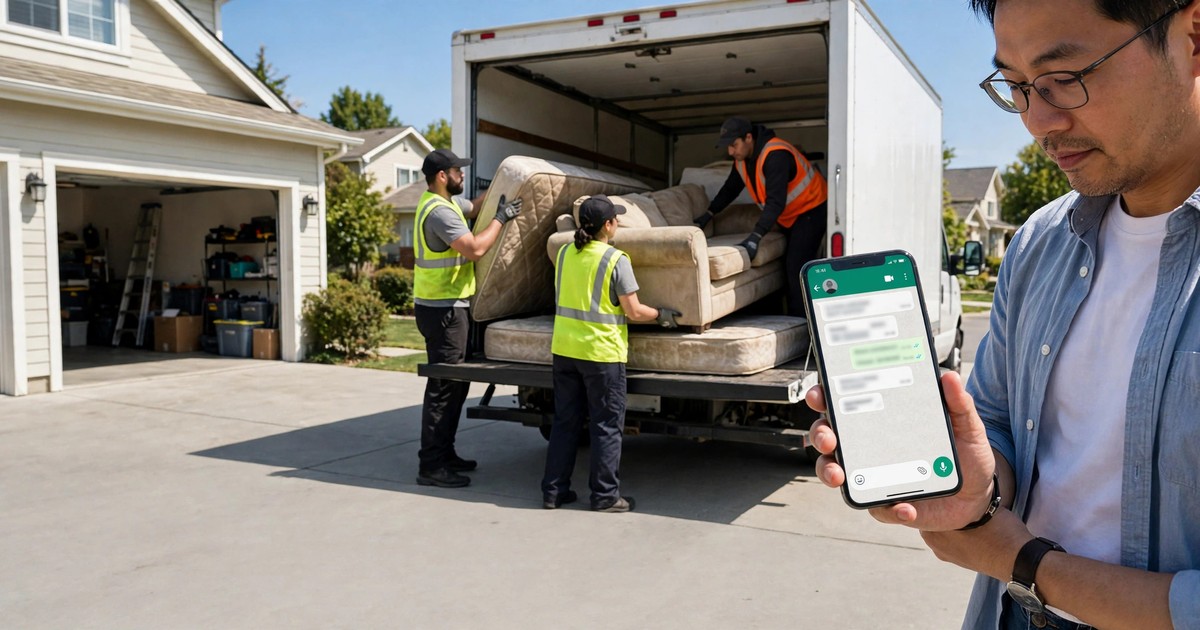
The truck is half loaded, your gloves are filthy, and the phone in your pocket is buzzing with a photo of somebody else's garage. A sofa, two mattresses, a broken wardrobe, and a message underneath: "How much to take all this away, and can you come today?" You will see it at lunchtime, or after the last tip run, and by then the customer will have booked the hauler who answered in two minutes. That is the whole problem this article solves, and it solves it in the place your customers already message you.
WhatsApp automation for junk removal companies is an AI assistant on your business number that answers pile-photo messages in seconds, asks the load and access questions, sends a load-priced quote you approve, and books the pickup with a deposit link and pickup-day updates, so jobs stop slipping away while your crew is loading a truck.
If you haul for a living, you already know the pattern. Most of your quotes arrive as photos, not phone calls, and they arrive while you are working. A mover sells a date and a crew, which is why our guide to WhatsApp automation for moving companies talks about rooms and staircases, but you sell truck space, and truck space is priced from a photo. A storage company sells a unit, which is why WhatsApp automation for self storage talks about sizes and move-in dates. You sell the empty truck that leaves a driveway clean, and your chat has to price a pile, check the access, and hold a slot, all before the customer messages the next hauler. This article gives you the full method: the questions, the price structure, the refused items, the pickup-day messages, and the honest limits. Read it once and you could run most of it by hand tomorrow. The automation simply runs it at 2am, on a Sunday, and in the middle of a tip run, without you touching your phone.
Why the fastest pile quote usually wins the pickup
A junk removal job is not a considered purchase. Nobody spends a week comparing haulers for a garage they want empty before the weekend. They message two or three companies at once, often with the same photos, and they pick the one that feels real first: a fast reply, a clear price, a date they can hold. The second reply, however good, arrives after the decision is made, and it reads like a backup plan.
That speed gap is where small haulers lose without realising it. You are the driver, the loader, the estimator, and the receptionist, and the phone is the one job you cannot do while doing the others. A quote request that sits unread for three hours is not a delayed reply. It is a lost pickup, a lost tip fee, and a lost review, because the customer who got a fast answer tells their neighbours who cleared their garage, and the customer who waited tells nobody.
There is a second cost that hurts more quietly. When you finally reply in the evening, tired and in a rush, you quote from a photo you glanced at, miss the mattress fee, forget to ask about the stairs, and arrive to a bigger load than you priced. The customer feels ambushed, you feel cheated, and the job ends with a negotiation on the driveway instead of a clean load and a card payment. Speed without structure creates that argument. Speed with the right questions prevents it.
What WhatsApp automation for junk removal companies actually does
Take the best estimator on your team, the person who looks at a pile photo and knows in ten seconds whether it is a half load or a full one, and give that person the ability to answer every message at once, day and night, in your company's voice. That is the assistant, running on the WhatsApp number your customers already use. It does not replace you. It does the first five minutes of every enquiry, the part that currently happens in your pocket while you work, and it hands you a clean job sheet to approve.
It greets the customer and asks for the photo if one has not arrived yet. It asks where the pile is, what floor it is on, whether there is lift or stair access, where the truck can park, and when the customer wants it gone. It works out a load size from the photos and your price list, and it sends you the draft quote before it reaches the customer, if that is how you set it up. When you approve, it sends the quote, the deposit link, and the slot hold. After the booking, it sends the pickup-day messages, the payment link, and the review ask that evening. Nothing in that chain needs your hands until the moment a human decision is required, and the assistant says so plainly when that moment comes.
Before any of this works, the number itself has to be set up properly. Our WhatsApp Business API setup guide walks through the business number, the approved message templates, and the opt-in rules that keep you inside WhatsApp's policies. The short version is simple: customers message you first, you reply inside the conversation they started, and marketing messages only go to people who asked for them. Build on that foundation and the rest of this article is just good questions asked in the right order.
How a pile photo becomes a price
Every hauler prices differently, but every honest pile quote answers the same three questions: how much truck space, how hard is it to get out, and is there anything in it that costs extra to dispose of. The assistant's job is to ask those three questions in plain language, so the customer answers them without feeling interrogated.
It starts with the photo, and it asks for a useful one. "Could you step back and take one photo of the whole pile, plus one close photo of anything big or awkward?" A wide shot shows the load. A close shot shows the fridge, the piano, the hot tub, the pile of paint tins hiding at the back. If the photo is dark or cropped tight, the assistant says so kindly and asks for one more, instead of guessing. A quote built on a bad photo is a dispute waiting for a driveway.
Then comes the reference question, the one most haulers forget to ask. "Is there a door, a car, or a person in the photo I can judge the size by?" A pile next to a standard door reads very differently from a pile photographed close up, and customers rarely think to include scale. One question about scale turns a guess into a load fraction: a quarter load, a half load, three quarters, or a full truck. Load fractions are the language your customers already understand, because they have seen them on every hauler's website, and they are the language your quote should speak. Website builders have made the same point from the other side: a junk-removal site earns its keep when a customer can send pile photos and get a load-priced quote without driving a truck out first, as the Zarla junk removal builder page shows with its photo-quote form and load-size pages. WhatsApp simply puts that same quote inside the chat where the photos already live.
Access comes next, and it changes the price more often than the pile itself. Ground floor garage with a clear driveway is one job. Third floor flat, no lift, narrow stairs, and a truck parked two streets away is a different job, even with the same sofa. The assistant asks about floor, lift, stairs, parking distance, and gate codes before it quotes, not after. It also asks what stays behind. "Is there anything in the photo you want to keep?" saves more arguments than any other single question, because nothing poisons a clearance like a crew loading the one chair the customer meant to keep.
Finally, the assistant names what could change the price on site, in the quote itself. "This price covers the pile in the photos and the access you described. If there is more than shown, or the stairs are tighter than described, we will agree the difference before we load anything." That sentence is not small print. It is the difference between a customer who nods and a customer who argues, because it was said before the truck arrived, not after.
The chat, step by step: from "hi, can you take this?" to a booked slot
Here is how a good chat actually runs, message by message, for a garage clearance on a Tuesday. The customer sends a photo and a short message. The assistant answers in seconds, warmly and in your voice: "Thanks for the photo, I can see the sofa, the two mattresses, and the wardrobe. Is it all going, and is there anything else in the garage that is not in the picture?" That one reply does three things: it proves a human-like eye looked at the photo, it confirms the scope, and it invites the missing items before the price is set.
The customer adds a broken treadmill they forgot. The assistant asks the access questions in one short message, not five separate ones: "Ground floor, and can we park right outside? And is there a gate code or a dog we should know about?" Short messages, one question at a time, feel like a conversation. A wall of questions feels like a form, and customers abandon forms.
Then the load and the price. "That looks like a half load, plus the mattress fee for two. All in, that is your half-load price plus the mattress fees, including the tip fee, and we can hold Thursday between 9 and 11. Shall I hold that slot while you decide?" The quote states the load, the extras, what is included, and the next step, which is a yes-or-no question, not an open-ended "let me know". If the customer hesitates, the assistant offers the deposit link as the way to hold the slot, not as pressure: "A small deposit holds Thursday, and it comes off the final bill. No deposit, and the slot stays open to the next enquiry." Honest scarcity, stated once, beats three follow-up messages.
When the customer says yes, the booking confirmation lands in the same chat: date, window, address, load size, price, what is included, and what to have ready. The customer can check it without digging through emails. You get the job sheet: name, number, address, photos, load fraction, access notes, gate code, and the slot. Read it between jobs and you know exactly what you are driving to.
What you take, what you never take, and how the chat says no kindly
Every hauler has a list, and most customers have never seen it. They photograph a pile that includes the one thing you cannot legally take, and they find out on the driveway. The chat should surface that item in the first exchange, not at the loading stage, and it should say no in a way that still helps.
The assistant asks a direct question early: "Any paint tins, tyres, gas bottles, chemicals, or fridges and freezers in the pile?" Those five cover most refusals, and naming them prompts the customer to remember the paint tins at the back of the garage. For each refused item, the assistant gives a reason in one line and a next step, not a lecture. Paint and chemicals go to the local household waste site, and the assistant says which type of site takes them, without pretending to know every council's opening hours. Tyres go to a tyre shop or a specialist collector. Gas bottles go back to the supplier. Fridges and freezers need a licensed refrigerant handler, and if you are not one, the assistant says so and suggests the customer ask their fridge collector for proof of certification, because an uncertified fridge ending up fly-tipped is the hauler's reputation on the line too.
Your customers are already on WhatsApp
ReplyPilot turns your business WhatsApp into an always-on front desk — instant answers, real bookings in your calendar, and a clean handoff to you the moment a conversation needs a person.
Ask on WhatsApp — it's freeThe honest no is one of the most trust-building sentences in this trade. "We do not take that, but here is who does" costs you one item and wins you the rest of the pile, and often the customer's next clearance too. Customers remember the hauler who told the truth about the fridge, and they call the same hauler when the garage needs clearing again. The assistant can even capture the customer's details for the standard load while declining the single item gracefully, so a refused fridge does not mean a lost customer.
There is a second list worth writing down: the items that need a question before they are quoted. Pianos, safes, hot tubs, large aquariums, and anything that needs more than two people or specialist equipment. The assistant flags these in the chat, explains the extra crew or the specialist step in plain words, and adds the fee to the quote transparently. No surprises, no awkward extra charge on the driveway, and no crew arriving to a piano they cannot move.
Pricing it honestly: load, item, and hourly
Haulers price three ways, and customers understand all three if you state which one you are using. Load pricing charges by truck space: quarter, half, three-quarter, full. Item pricing charges per piece: per sofa, per mattress, per appliance. Hourly pricing charges for crew time, and it suits big, unpredictable clearances where the load is unknown until the crew is inside. The assistant should name the method in the quote, every time. "Priced as a half load" is a clear sentence. A bare number with no method is an argument waiting to happen.
Load pricing works best for the photo-quote chat, because the photo shows the load. Item pricing works best for single-item pickups, where the customer knows exactly what is going. Hourly pricing needs the most careful wording in chat, because the customer hears a clock running. If you price hourly, the assistant should state the crew size, the minimum time, what is included, and the point at which it stops and calls the customer: "Two crew, minimum one hour, and we stop and agree before going past two." That stop-and-agree rule is the sentence that makes hourly pricing feel fair instead of open-ended.
Whatever method you use, three lines belong in every quote. What is included, including the tip fee and any mattress or appliance fee. What is not included, including waiting time beyond a stated window and items you do not take. And what changes the price, including more load than photographed and access tighter than described. Write those three lines once, use them in every quote, and watch driveway negotiations disappear. The customers who argue about price almost always argue about a line that was missing, not a number that was high.
Same-day jobs and estate clearances need different chats
Not every pile wants the same conversation, and the assistant should know which job it is handling before it sets its pace. A same-day job is a speed job. The customer wants it gone today, the slot is the product, and every extra question costs the booking. The chat stays short: photo, load, access, price, deposit, slot. If the customer goes quiet for ten minutes, the assistant checks back once, because a same-day customer who goes quiet has usually booked someone else, and a fast nudge sometimes wins them back before they pay a deposit elsewhere.
An estate clearance is the opposite job, and rushing it is a mistake. The customer is often a son or daughter clearing a parent's house, or a landlord clearing a flat after a tenancy, and they are not in a hurry so much as they are overwhelmed. The assistant slows down. It asks who the contact is, whether anyone needs to be present, whether there are items to set aside for family, and whether the customer wants a room-by-room approach or the whole property at once. It offers a walkthrough visit before a firm price, because a house clearance cannot be priced honestly from three photos, and it says so. It names one contact for the job, so the customer is not repeating the story to a different voice each time. Patience in this chat is not softness. It is the reason that customer recommends you to the solicitor, the estate agent, and the next family in the same street.
There is a third job type hiding inside both: the landlord or property manager with repeat work. They do not want a warm chat. They want a fast price, a clean invoice, and a photo of the empty property when the crew leaves. The assistant learns that from the first job and shortens every later chat accordingly: same questions, fewer words, invoice attached in the chat, empty-property photo sent before the crew drives away. Repeat customers are where a hauling business becomes stable, and the chat should treat them like regulars, not strangers.
Pickup day without the phone calls
Pickup day is where most haulers lose the morning to the phone. "Where are you?" "Can you come earlier?" "The gate is locked, what is the code?" "Can you take this extra bag too?" The assistant removes most of those calls with four messages, sent before the customer thinks to ask.
The evening before, a confirmation: tomorrow's window, the address, the load, and one question, "Anything changed since the photos?" That question catches the extra bags before the truck leaves the yard. On the morning, a crew-on-the-way message with a realistic window, not a promise the traffic cannot keep. "Crew left at 8:20, aiming for between 9 and 10" is honest. "There in 20 minutes" is a broken promise when the previous job runs long. Customers accept a wide window. They do not accept learning about a delay from an empty driveway.
When the crew arrives, the chat handles the two things customers actually ask on the day: the extra item and the payment. For the extra item, the assistant's rule is simple and should be set before the job: small extras within the quoted load go on the truck and the price stands, and anything that pushes the load into the next fraction gets agreed in the chat before loading, with the new total stated plainly. For payment, a card link in the chat beats cash on the driveway, and it beats an invoice that chases the customer for a week. The customer taps, pays, and gets a receipt in the same conversation they booked in.
After the crew leaves, two messages close the job properly. A photo of the cleared space, sent in the chat, proves the work and gives the customer something to show their partner or their landlord. And if anything was donated or recycled, a short note saying so, naming the type of item and not inventing a charity name, gives the customer a reason to feel good about the clearance instead of guilty about the waste. That evening, the review ask arrives, short and warm, with the link. Happy customers rarely review on their own, because they are busy enjoying the empty garage. They just need to be asked, at the moment the relief is fresh.
Mistakes that cost haulers jobs
The technology only works if the chat feels like your business, and a few mistakes undo it fast. The first is quoting from one bad photo. If the photo is dark, cropped, or missing the awkward item, ask for another before you price. A fast wrong price is worse than a slow right one, because the wrong price becomes a promise the customer holds you to on the driveway.
The second is skipping the access questions. Floor, lift, stairs, parking, and gate code take thirty seconds in chat and save thirty minutes on the job. A crew that arrives to a third-floor flat with no lift and a truck parked two streets away has lost the morning, and the customer has lost patience, before a single item is loaded.
The third is the vague quote. "Around this much, depending" is not a quote. It is a suggestion, and customers treat it as one. State the load, the method, the extras, what is included, and what could change it. A customer who understands the quote defends it to their partner. A customer who does not understand it shops it around.
The fourth is letting the assistant handle damage or complaint chats. A customer who messages angry, because something was scratched or an item was taken by mistake, goes to a human immediately, every time. The assistant's only job there is acknowledgement and a callback time it can keep: "I am really sorry, let me get this in front of the owner right now, and you will hear back within the hour." A bot that argues, quotes policy, or promises a refund is how one-star reviews are born.
The fifth is forgetting the quiet quotes. Most quotes do not get a yes or a no. They get silence, because the customer meant to decide and then the week happened. A gentle sequence recovers a share of them: day two, a check that the quote arrived and an offer to answer anything; day five, a note that the slot is filling and an offer to hold it; day ten, a friendly close. The tone matters enormously here. These are helpful check-ins from a company that has its act together, not sales pressure, and each one includes a reason to reply: a question answered, a slot held, a detail clarified.
Your first two weeks: set it up without stopping the truck
Start with the words, not the software. Write your real price list first: load fractions, item fees, mattress and appliance fees, what is included, and the refused-items list. Write the access questions in order, and the three lines that belong in every quote. Write the pickup-day messages and the review ask. This is the assistant's brain, and it must be your truth, not a generic template's guess. A week spent writing honest words beats a day spent connecting tools to vague ones.
Then connect the number your customers already message, and run a quiet week. Let the assistant handle new enquiries while you review every quote before it sends. Read the transcripts in the evening, especially the ones that went quiet, and tighten one question at a time. You will spot the question customers stumble on, the photo request they ignore, and the price line they query, and each fix makes the next week's chats smoother. After that week, switch on the pickup-day sequence and the review ask. Start with enquiries and quotes, because the fastest payback is in the opening minutes of every enquiry, and add the rest once quoting feels right.
Compare the options honestly before you commit. Answering yourself costs your evenings and loses the jobs that arrive while you load. A part-time phone person answers fast but knows nothing about your loads, your tip fees, or your refused items, and costs a wage whether the phone rings or not. A generic call centre answers faster still and knows even less about your truck. Automation is the combination that matters for a hauler: your knowledge, your price list, your voice, delivered at call-centre speed, on the number customers already use. That combination is the entire edge, because in this trade the customer hires the hauler who answers first with a clear, confident price, and the assistant answers first every time.
If you want that setup for your own trucks, the natural next step is a free custom demo built around your services, your load prices, and your refused-items list, so you can see your own pile-photo chat working before you commit to anything. A ready-made setup costs $249 in total, split as a $125 deposit and $124 at go-live, and the optional Care Plan is $99 a month for ongoing tweaks, transcripts review, and support. That is the honest price, stated here the way it should be stated in your own quotes: what it is, what it includes, and no surprise later. Start with the price list and the questions in this article, and whether you automate them this week or next, the next pile photo that arrives while you are loading a truck will not have to wait for your evening to become a booked pickup.
Frequently asked questions
Can WhatsApp automation quote a fridge that still has food in it?
Yes, but the chat should ask about it before the price is set. A fridge with food inside takes longer to clear, may smell, and needs the customer to confirm it is switched off and emptied as far as possible, or to accept an extra handling note. The assistant asks one plain question, "Is the fridge empty and switched off, or does it still have food in it?", and adjusts the note on the job sheet. If you are not licensed to handle refrigerant, the chat says so and points the customer to a licensed collector, rather than booking a job you cannot legally finish.
Do you charge extra for a mattress, and why?
Most haulers do, because mattresses cost extra at the tip and cannot go in with general waste, and your chat should say that in the quote, not on the driveway. The assistant counts mattresses from the photos, adds the per-mattress fee to the load price, and states it as a line in the quote. Customers accept a fee they understand. They argue about a fee that appears after the work is done, so the fee belongs in the first price they see.
What happens to things left behind after a clearance?
The assistant asks before the job, not after, whether anything found during the clearance should be set aside, donated, or disposed of, and who decides. For estate clearances, it asks for a named contact and a rule: valuable-looking items are photographed and set aside for the contact's decision, and everything else follows the agreed plan. That one rule prevents the hardest conversation in this trade, the one about something that is already at the tip, and it costs nothing to set in the chat.
Can you clear a flat with no lift?
Yes, and the chat must price it as a stairs job from the start. The assistant asks the floor, whether there is a lift, how wide the stairs are, and whether large items come apart, then adds the stairs note to the quote and the crew size to the job sheet. A flat with no lift is not a problem. A flat with no lift that was quoted as a ground-floor job is a problem, and the difference is one question asked early.
Can I pay by card on the driveway?
Yes. The assistant sends a payment link in the same WhatsApp chat when the load is complete, and the receipt lands in the same conversation. Customers who pay by link do not need to find cash, and you do not chase an invoice for a week. If a customer prefers cash or bank transfer, the chat records that choice on the job sheet, so the crew arrives knowing how the job will be paid, not guessing on the doorstep.