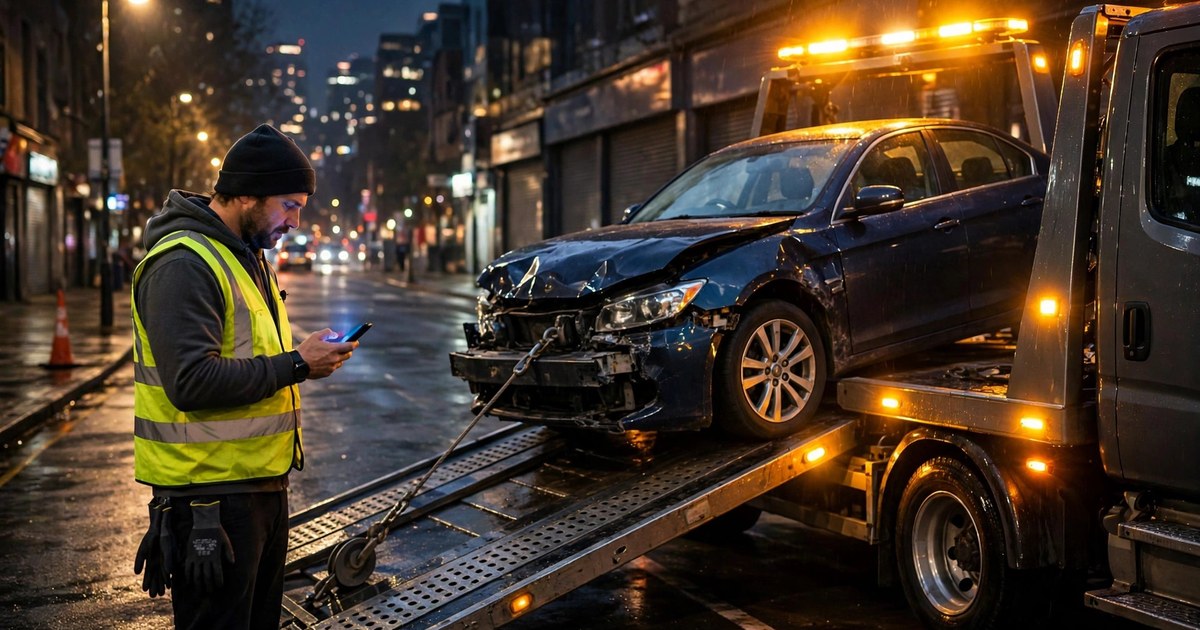
It is 2:07 on a wet Tuesday morning, and a family van has died on the hard shoulder of the motorway, hazard lights blinking, rain on the roof, and two tired kids in the back seat. The driver finds CityLine Towing on her phone, taps the WhatsApp button, and types: "Van will not start, we are stuck near the junction, please help." CityLine is a good firm. The owner, Danny, runs three trucks and knows every back road in town. But Danny is asleep with his phone on silent after a sixteen hour day, and his night driver is out on a highway job with his hands on a winch cable. The message sits unread.
Eight minutes later, the family messages the next firm on the list. That firm replies at once, asks for a location pin, and sends a truck. CityLine did not lose that job because its price was wrong or its work was poor. It lost the job in silence, before anyone at the firm even knew the job was there. That is the gap WhatsApp automation for towing companies is built to close.
WhatsApp automation for towing companies is a setup on your business number that replies at once, asks for a location pin, the vehicle, and the problem, gives a clear quote from your own price list, passes the job to a driver, sends ETA updates and a payment link, and asks for a review when the job is done.
Why does a stranded driver pick the second company on the list?
A person who needs a tow is not calm, and they are not patient. Their car has failed in a dark car park, on a busy road, or far from home. They may be late for work, worried about cost, or scared about standing near fast traffic. In that state, people do not weigh up five websites like they would when buying a sofa. They reach out to one firm, wait a short while, and then reach out to the next one. The first firm that answers feels like the firm that can help. The firm that stays silent feels closed, even if its trucks are ten minutes away.
Think about when these messages land. Breakdowns do not keep office hours. They happen on the school run, in the Friday rush, and in the middle of the night, usually when you are under a car, driving a loaded flatbed, or talking to police at a crash scene. You cannot type a careful reply with greasy hands, and you should not try while driving.
There is a second cost that owners miss. A missed message is not just one lost tow. That driver tells friends which firm left them waiting, and saves the number of the firm that did come. Next time their battery dies, they call the firm that answered. One silent night can hand a whole household of future work to a rival. Fast first replies are not a nice extra in this trade. They are the front door of the business, and at 2am that door is usually locked.
What does WhatsApp automation for towing companies actually do?
Think of it as a night dispatcher who lives inside WhatsApp and never sleeps, never forgets a question, and never mixes up two jobs. It works from facts you give it: your service area, your truck types, your callout rules, and your price list. It does not guess. It follows your playbook, in your tone, and writes everything down in one clean thread you and your drivers can read at a glance.
Here is the work it takes off your plate:
- Replies in seconds to a new message, so the customer knows help is being sorted and does not drift to the next firm.
- Asks the customer to share a live location pin, instead of a vague note like "near the big petrol station".
- Asks what the vehicle is, whether it starts, whether the wheels turn, and whether anyone is hurt or in danger.
- Works out the right truck for the job, such as a flatbed for a car that cannot roll or a wheel lift for a short city tow.
- Sends a clear quote from your own rates, with the callout, the tow, and any extra work named apart.
- Passes the full job to the right driver or to you, with the pin, the vehicle, the problem, and the price the customer agreed.
- Sends ETA updates when the truck is on its way, so the customer is not left staring down a dark road.
- Sends a payment link for card payment, or notes clearly if the customer will pay cash to the driver.
- Asks for a review after the drop, while the relief of being home is still fresh.
Other trades use the same first-reply idea in their own way: locksmiths around night lockouts, in our guide to WhatsApp automation for locksmiths, and plumbers for burst pipes, in our piece on an AI chatbot for plumbers and home services. Towing needs its own version, because no other trade starts with a scared customer, a live location pin, and a truck that must be the right size for the vehicle at that pin.
What happens step by step when a breakdown message lands at 2am?
Let us walk through the CityLine job again, with the setup live. The same mother sends the same message at 2:07. This time she gets a reply almost at once. It is calm and short. It says the firm has her message, asks if everyone is safe and out of the road, and tells her what happens next. That first reply does a quiet job on its own: she stops looking for other firms.
Next, the flow asks for the facts in the order a dispatcher would. First the location pin, because a pin ends the worst mix-ups in towing: wrong junction, wrong side of the highway, a car park with three exits. Then the vehicle: make, model, and colour. Then the problem: will it start, is it an accident, is a wheel damaged, is the car blocking traffic? Then where the car needs to go: home, a garage, or your yard. Each answer lands in the job record as she types.
With those facts, the setup gives a quote from Danny's real rates and says plainly what the quote covers and what could change it, such as a car that needs skidding onto the bed. She taps to accept. She gets a booking note in the chat, and the job goes to the driver on night duty with the pin, the vehicle facts, and her phone number. The driver taps accept, and she gets an ETA update. At the drop, she pays by card through a payment link, and the next morning she gets a kind request for a review. Danny wakes up to a paid job and a full written record, instead of an unread message and a lost night.
What it does NOT do, and why that honesty keeps you safe
A good setup has hard edges, and you should be glad of them. It does not drive the truck, winch the car, or judge a crash scene. If someone says a person is hurt, a car is on fire, fuel is leaking, or traffic is at risk, the flow must stop selling and tell the customer to call the emergency services at once, then alert you right away. Safety words come before booking words, every single time. Build that rule first, before prices, before polish.
It also does not invent prices. If a job falls outside your list, it says the driver or the office will confirm the price, and it passes the chat to a human. It does not promise an arrival time your trucks cannot keep. It gives honest windows based on the driver you assign, and updates the customer if the job before runs long. A wide honest window keeps trust. A tight false promise kills it.
Last, it does not pretend to be a person. It says it is the firm's automated helper, and it hands over to a human the moment a chat needs one: an angry customer, a strange request, a serious crash, or anything that feels off. That hand-off is not a flaw. It is the system working as it should. The tool wins the first minutes and keeps the record straight. Your people handle the parts that need heart and judgement.
Want this for your towing companies?
ReplyPilot builds a custom whatsapp automation setup for your towing companies — answering customer questions instantly, taking orders and bookings, and handing off to you when a human is needed.
Ask on WhatsApp — it's freeCan it handle police, insurance and impound jobs without a mess?
Yes, if you set up paths for them, because these jobs run on facts and paperwork. A police tow request often comes with tight rules: where the vehicle must go, who may collect it, and what must not be touched. The flow can mark the job as a police request, record who asked for it, and send it straight to you or your senior driver instead of treating it like a normal booking. An insurance job needs other facts: the insurer name, a claim number if there is one, and where the insurer wants the car taken. Asking for those in the first chat saves a slow chain of calls the next day.
Impound and yard questions are where the written thread earns its keep. People ask the same hard things again and again:
- Where is my car being held, and when can I come?
- What ID and papers do I need to bring to get it back?
- What are the daily storage fees, in plain words?
- Can someone else collect the car for me?
- What happens if I cannot pay the full amount today?
Each of these has an answer you give every week without thinking. Write your real answers once, in plain words, and the setup gives them the same way at noon and at midnight. It never argues, never guesses at fees, and it passes any dispute to you fast with the full thread attached. That calm written record also protects you: what was said, what was quoted, and what the customer agreed to is all in one place, not split across three phones and a paper pad in the cab.
If you want to see how a setup like this could look on your own number, ReplyPilot can build this kind of WhatsApp flow for your towing firm and show you a free demo with your services, your area, and your rates in it, so you can judge the real thing instead of a sales promise. There are no guarantees with any tool, but a demo on your own jobs is the fastest honest way to see if it fits your yard.
Mistakes That Kill Towing Automations Before They Win a Job
Most failed setups do not fail because the software is weak. They fail because the owner skipped the groundwork. Watch for these:
- Loading made-up prices, then arguing with customers who were quoted a number nobody at the firm had ever charged.
- Promising exact arrival times in the first message, before a driver has even accepted the job.
- Asking ten questions before asking if anyone is hurt or in danger.
- Forgetting the location pin, so drivers hunt for a car described as "past the shops, near the lights".
- Letting the flow take accident or injury jobs like normal bookings, instead of sending them to emergency services and to you at once.
- Sending bulk messages to old numbers without consent, which can put the business number itself at risk.
- Going live without reading test chats, so the first real customer finds the gaps at 2am.
Every item on that list has the same root. The setup was treated like a gadget, not like a new member of staff. A new dispatcher gets your price list, your area map, your hard rules, and time to watch how you work. Give the automation the same training, and check its first chats the way you would check a new hire's first week.
DIY, a night dispatcher, or automation: which fits your yard?
You have three real choices. Doing it yourself costs the least money and the most sleep. It works when calls are few, and it breaks quietly the first busy night: you will never know which messages you slept through.
A night dispatcher or answering service gives you a human voice, and a good one is worth a lot. But cover costs real money every month, and a message taken is not a job dispatched. Someone still has to quote the work and assign a truck, and at 3am that someone is often still you.
Automation sits in a different spot, and its cost falls into bands rather than one fixed figure. A simple software-only setup is the low band: you connect a tool, load your own words, and run it yourself. A done-with-you setup is the middle band: someone builds your flows, loads your rates, and tests them with you. A custom setup tied into dispatch or yard software is the top band. In every band, ask what the full bill holds: the platform fee, per-conversation charges on the official WhatsApp side, setup work, and support. Our WhatsApp Business API setup guide walks through what that official route involves. For most small and mid-size firms, the mix that pays is simple: automation takes the first reply, the facts, the quote, and the updates, and humans take the hard calls and the driving.
How do you set this up in one week without stopping the trucks?
You do not need to stop work or change your number to start. On day one, write down the facts the setup must know: your service area, your trucks and what each can carry, your callout and tow rates, your yard address and hours, and your rules for police, insurance, and impound work. If you cannot write a price down, the flow must not quote it.
On days two and three, build the main flow: the first reply, the safety check, the location pin, the vehicle questions, the quote, the driver hand-off, the ETA updates, and the payment link. Add the yard questions as a short second flow. On day four, test it like a customer: message your own number at odd hours, and try a flat battery, a motorway breakdown, an accident job, and an impound question. Fix anything that sounds cold, rushed, or wrong. On day five, run it live but watch it closely, and note every question customers ask that you had not planned for.
By the end of that week, count the jobs that came in after hours, the quotes sent in writing, and how many chats needed you to step in. Watch reply speed too, but do not worship it: a fast wrong answer helps nobody. The score that matters is paid jobs that would have gone cold without a reply, minus the time you spent fixing the flow. After that, keep it simple: one small fix a week, one new answer when a new question shows up, and a short look at the numbers each month.
Frequently asked questions
Can a customer really send a location pin, or will they get confused?
Most customers can, because WhatsApp puts the pin in the same attach menu they use for photos. The flow guides them in one short line: tap the paperclip or plus sign, tap Location, then send your current location. If a customer cannot do it, the flow falls back to simple facts: road name, nearest junction or landmark, direction of travel, and what they can see. The pin is the best answer, not the only one.
What if the customer needs help right now and someone is hurt?
The flow must stop the booking path at once. If a customer mentions an injury, fire, leaking fuel, or danger from traffic, the reply tells them to call emergency services straight away and gives no repair or moving advice. It also alerts you or your on-duty driver at the same time, with the location and facts it already has. You set these trigger words before launch, and you test them yourself.
Do I need a new phone number for this?
In most cases, no. Many firms run the setup on the number customers already know, moved onto the official WhatsApp Business route. What matters is that the switch is handled the right way, because a badly handled change can disturb the very line your work comes in on. Ask whoever builds it how the change is done and what happens to your existing chats, and get that answer in writing.
Can it take payment, or do drivers still handle money?
It can send a payment link in the chat, so a customer can pay by card before the truck arrives or right after the drop, with the payment record in the same thread as the quote. Cash still works the old way: the flow notes that the customer will pay the driver. What it should never do is ask for full card details typed into the chat. Links from a proper payment provider are the safe route.
What happens when two jobs come in at the same time?
The setup can hold both chats at once, take the full facts for each, and pass both to you or your drivers in the order they landed, with urgency marked. It does not decide on its own which family gets the only truck, unless you gave it a clear rule. That call stays human. What the tool removes is the chaos: no lost second caller, and no mixed-up pins.