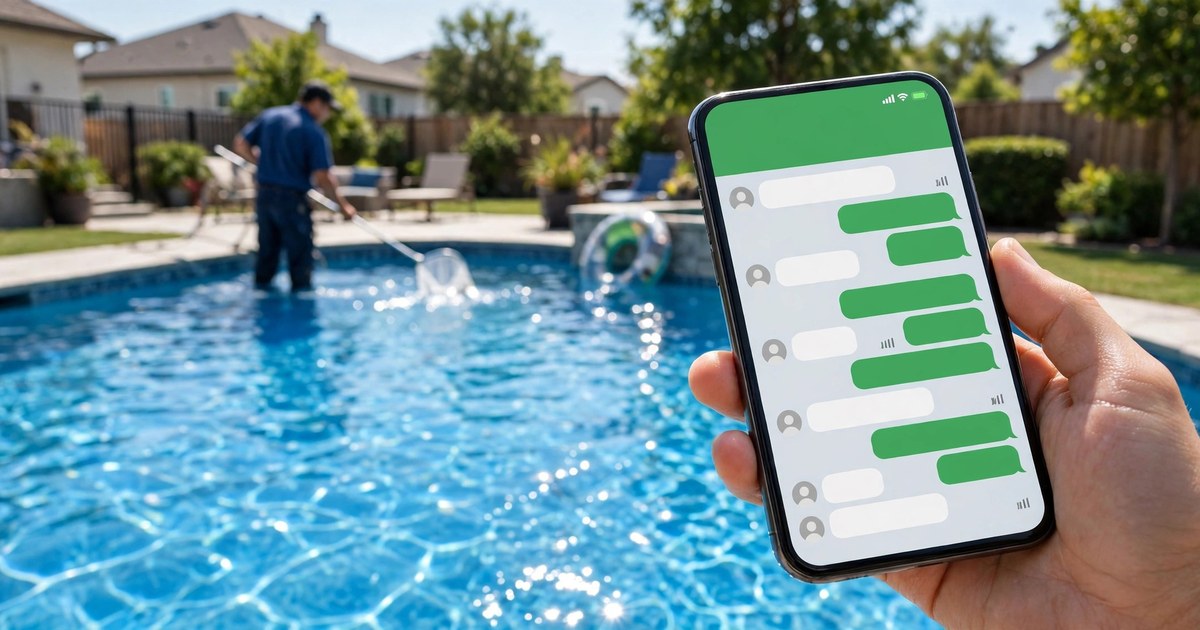
It is 8:15 on a Saturday morning. A dad stands at the edge of his pool, staring at green water. His daughter's birthday party starts at two — twelve kids, a cake shaped like a dolphin, and a pool that looks like a swamp. He does not call a pool company. He opens WhatsApp and messages the first one whose number he finds.
You are on a route across town, skimmer in hand, phone in the truck. You see his message at lunch. By then he has hired whoever answered first — a competitor who was also on a route, but whose WhatsApp answered for him.
That is the whole story of the pool business in one morning: the jobs go to whoever answers first, and the owner is always somewhere a phone cannot be answered. WhatsApp automation is how the first company to answer is always you — even when your hands are wet.
Quick answer: WhatsApp automation for pool service companies answers every customer message in seconds, day or night. It signs customers up for weekly cleaning routes, sends chemical-balance photo reports after each visit, reschedules rain days automatically, and runs pool opening and closing campaigns. It turns one-time cleanings into recurring revenue — without missed messages.
What WhatsApp automation actually is for a pool service company
Think of it as the office manager who never sleeps, never takes a day off, and knows your routes by heart. A customer messages your business on WhatsApp, and the assistant replies instantly with a real conversation — not a dead "we will get back to you." It figures out what the customer needs, collects the details, and books the visit or signs them up for the route. You step in only for human decisions.
It runs on the official WhatsApp Business Platform — the approved way for software to send and receive WhatsApp messages. That keeps your number safe and unlocks what the free app cannot do: real back-and-forth conversations, approved message templates, and booking links. The official platform documentation is here: WhatsApp Business Platform
Here is what it does for a pool service business:
- Answers every message in seconds, 24 hours a day — even from the truck.
- Signs customers up for weekly or bi-weekly cleaning routes with two or three questions.
- Sends chemical-balance photo reports after each visit, automatically.
- Reschedules rain days and notifies the whole route in minutes.
- Runs pool opening and closing campaigns each season.
- Collects photos of green pools, broken pumps, and torn liners for faster quotes.
- Asks for reviews after cleanings, when customers are happiest.
- Sends filter-cleaning and equipment-check reminders that bring back old customers.
The automation handles the conversation; your crew handles the water. That split is the whole point.
The green-pool Saturday: turning panic into a booked route
Pool emergencies follow a pattern that favours whoever answers first. The water turns green the week of a party, a holiday weekend, or the first hot spell — and every hour of silence pushes the customer toward the next company in the results. The catch: "my pool is green" can mean very different jobs. An algae bloom after a storm is a shock-and-brush visit. A green pool with a dead pump is a repair job first, cleaning second. A pool that has been green for months might need a drain and acid wash — a full-day job with a very different price.
Your automation sorts this with three questions. Here is how the conversation flows:
Customer: My pool turned green and we have a party Saturday! — Automation: I can help — green pools are our specialty. First: is your pump running right now, or is it dead silent? — Customer: It's running, I can hear it. — Automation: Good — that means we can usually clear it without draining. Second: when did it turn green — this week, or has it been a while? — Customer: Just this week after the storm. — Automation: That's an algae bloom — very fixable. Third: can you send me a quick photo of the water? — Customer: [photo] — Automation: Got it. We can shock, brush, and balance it before Saturday. I have Thursday or Friday morning — which works?
Three questions turn panic into a booked slot in under two minutes. And here is the part most pool companies miss: after the cleanup, the automation offers the weekly route — "want us to keep it this clear every week? It's one visit, same day, and you never think about chemicals again." The emergency visit becomes a recurring customer. That is where the real money in this business lives.
If turning chats into booked jobs is where your business leaks most, our lead capture automation guide covers the full capture-to-booking pipeline: lead capture automation guide
Weekly route signups: your recurring revenue machine
Ask any pool company owner what they want more of: not one-time cleanings — routes. A customer on a weekly route is worth twelve visits a year, paid like clockwork, scheduled on your most efficient day. The problem has never been demand. It is friction: the customer has to call during office hours, wait on hold, answer the same questions, and agree to a schedule while standing in their kitchen. Half of them never finish the call.
WhatsApp route signup removes every step that is not a decision. The customer messages "how much for weekly cleaning?" The automation asks for the address and pool size — small, medium, large, or "not sure" — and gives your route price for their area. Then it offers your route days: "We service your street every Tuesday. Morning or afternoon?" The customer picks, leaves a name and number, and gets a confirmation with the first visit date. Four messages, ninety seconds, zero phone tag.
Two rules keep route signups honest. First, the automation quotes only the prices you wrote — flat route rates by area and pool size, nothing invented. Anything unusual — an indoor pool, a commercial property, a pool with a broken heater — gets "let me have the owner confirm this one personally." A wrong price given in writing loses the customer faster than a slow reply ever could. Second, every signup lands in one tidy thread: address, pool size, route day, gate code, dog warning, billing preference. Your crew sees the whole story before the first visit.
Chemical photo reports: the trust-builder competitors skip
Here is the quiet reason customers leave pool companies: they pay every month and have no idea what was done. The truck came, the truck left, the water looks the same. Doubt grows. Then a competitor knocks on the door with a flyer, and the customer switches — not because your work was bad, but because your work was invisible.
The chemical photo report fixes this in thirty seconds. After each visit, the automation sends the customer a message: the test strip photo or the digital reader result, chlorine and pH readings in plain words, what was added, and one photo of the clean pool. "Chlorine 2.0, pH 7.4 — both perfect. Added shock after the storm. Pool's sparkling — see you Tuesday." The customer sees proof of work every single week.
This does three things no flyer can beat. It makes your service visible, so the customer feels the value monthly. It creates a paper trail — when the water goes cloudy between visits, the report history shows it was balanced on Tuesday, which ends the "you never come" argument before it starts. And it generates replies: customers respond to the report with "can you also check the filter?" — which is an upsell conversation that starts itself.
The crew's part is tiny: snap two photos and tap the readings into the app. The automation writes the message, sends it to the right customer, and files it. Invisible work becomes visible work, automatically.
Want this for your pool service companies?
ReplyPilot builds a custom whatsapp automation setup for your pool service companies — answering customer questions instantly, taking orders and bookings, and handing off to you when a human is needed.
Ask on WhatsApp — it's freeRain days and reschedules: the headache, automated
Every pool company dreads the same morning: overnight storm, half the route underwater, and forty customers who all need to know their visit moved. The old way is forty phone calls or a group text that starts forty separate conversations. The owner spends the morning on the phone instead of fixing the schedule.
The automation does it in one pass. You tap "rain day — push Tuesday route to Wednesday." Every customer on that route gets a WhatsApp message: "Morning! Heavy rain overnight, so we're moving your cleaning from Tuesday to Wednesday — same time window. Reply YES to confirm or pick another day." Confirmations come back as simple replies, and anyone who needs a different day gets offered the open slots. The whole route is rebooked before your coffee cools.
The same system handles the small reschedules that eat afternoons: "can you come Thursday instead?" gets an instant answer with your real availability, and the calendar updates. No phone tag, no sticky notes, no double-booked Tuesdays. In a business where the weather rewrites your week, this is not a luxury — it is the difference between a chaotic season and a calm one.
Seasonal campaigns: openings, closings, and the quiet months
Pool season is short, and the companies that win it start before it starts. In early spring, the automation messages last year's customers: "Pool opening season is here — want us on the calendar before the rush? Reply OPEN and we'll schedule your cleaning and equipment check." The customers who reply get booked in order. The ones who do not reply get one friendly follow-up, then silence — no spam, ever.
In autumn the same list gets the closing campaign: winterizing, cover installation, equipment checks before the cold. And in the quiet months, the automation earns its keep with the unglamorous work — filter-cleaning reminders, salt-cell checks, "it's been six months since your last visit" nudges to one-time customers. Each message goes only to people who agreed to hear from you, using approved templates, which keeps your number safe and your reputation clean. Our broadcast playbook covers the compliance side in detail: WhatsApp broadcast marketing playbook
The math of seasonal campaigns is simple: you already paid to win each customer once. A message that costs pennies brings them back for opening, closing, and the mid-season check. Companies that run these campaigns stop starting every spring from zero.
Want this running for your pool company before the season turns? Message us on WhatsApp and we will map your routes, your prices, and your season into an automation that answers while you're on the truck: chat with ReplyPilot on WhatsApp
What it does NOT do (read this before you buy)
Honest talk first, because vendors will not give you this section. Automation will not clean a pool, diagnose a dead pump over chat, or quote a drain-and-acid-wash from one blurry photo — anything unusual still needs your eyes on it, and a good setup says so instead of guessing. It will not get you customers on its own; it handles the conversations you already have, so if nobody messages you, fix your visibility first. It will not survive on stale prices — when your route rates change, update them the same day, or the bot will quote last year's numbers with total confidence.
It also does not replace judgment on weather calls and angry customers. A furious customer with a green pool two days before a wedding needs a human voice, fast — the automation's job is to flag that conversation and get it to your phone in seconds, not to soothe anyone itself. Owners who understand this split — machine handles the routine, human handles the exceptions — get the full value. Owners who expect magic get disappointment.
Mistakes that kill pool-service automation
Most pool-company automations fail for boring, fixable reasons. Here are the five killers.
Mistake one: quoting prices the bot invented. The fastest way to lose a customer is a bot that quotes $89 for a route you charge $140 for. Root cause: nobody wrote the real prices down. Fix: give the automation your exact route rates by area and pool size, and a hard rule — anything unusual gets "the owner will confirm personally."
Mistake two: no photo habit. The chemical report only works if the crew actually snaps the photos. Root cause: the crew sees it as extra work. Fix: make it two taps in the app they already use, and show them the review requests it generates — techs who see their five-star reviews keep taking photos.
Mistake three: treating every message like a broadcast. Blasting promotions to customers who only agreed to service reminders gets your number flagged fast. Root cause: confusing a customer list with an audience. Fix: service messages to everyone, promotions only to people who opted in — and check the quality rating weekly.
Mistake four: the invisible handover. A customer with a real problem gets stuck in a bot loop with no way to reach you. Root cause: nobody wired the "talk to a human" escape. Fix: every flow ends with a human option, and handover messages go to a phone you actually check.
Mistake five: launching in peak season and walking away. The first month needs you reading conversations for ten minutes a day — fixing answers, adding the questions customers actually ask. Root cause: "set and forget" thinking. Fix: train it through one month, then it runs itself. The companies that skip training blame the tool; the companies that do it get an assistant that sounds like their best office manager.
DIY vs hiring a developer vs done-for-you
Three ways to spend your money. Doing it yourself with a WhatsApp automation tool costs a monthly subscription and two or three afternoons: you connect your number, write the conversation flows, set your prices, and test with real messages. Best for owners who are comfortable with software and have a slow week. Watch out for: the setup that never quite finishes because peak season arrived.
Hiring a freelancer costs a one-time build fee plus the monthly tool cost. You get custom flows, your calendar connected, your routes mapped. Best for companies with unusual needs — multiple crews, commercial accounts, custom billing. Watch out for: the builder who disappears after launch, leaving you with a system nobody understands when it breaks mid-season.
Done-for-you means a specialist builds it, trains it on your routes and prices, tests it with real customer questions, and monitors it through the season. You spend zero afternoons. Best for owners who are on the truck all day — which is most pool company owners. Watch out for: anyone who cannot show you real conversation examples from past work. If your bigger question is how the WhatsApp Business setup itself works, our setup guide walks through it step by step: WhatsApp Business API setup guide
Our honest take: if you have a quiet week and like figuring out software, try the DIY route — you will learn exactly what you need. If you are booking routes from the truck and the season is already moving, done-for-you pays for itself the first Saturday it answers the green-pool panic while you are underwater with a skimmer.
How to tell if yours is working
After thirty days, check three numbers. First, the answer rate: what share of messages did the automation handle without you? Healthy is most of them — if it hands over half, your prices or routes need clearer writing, not a better tool. Second, the route count: how many weekly signups came through WhatsApp this month versus last? One new route customer usually pays for the whole system. Third, the review rate: are the automatic post-visit review requests turning into Google reviews? Reviews are the compound interest of this business — every one makes next season's marketing cheaper.
One more test that costs nothing: message your own business at 9 PM as a stranger with a green pool. If the conversation books you a visit in under two minutes, you have a good one. If it loops, stalls, or quotes nonsense, fix the content before you blame the tool.
Getting started this week
The whole project in five steps. One: write down your route prices by area and pool size — the real numbers, no ranges you would not honor. Two: pick a WhatsApp automation tool and connect your business number through the official platform. Three: build the three flows that matter most — the emergency triage, the route signup, and the rain-day reschedule. Four: set up the chemical photo report habit with your crew. Five: test everything with twenty real messages, fix what breaks, and go live.
Then read the conversations for ten minutes a day for a month. Teach it the answers it missed. Add the questions customers actually ask. By the second month you will have an office manager who works the night shift, the rain days, and the Saturdays — and never asks for a raise.
The pool companies winning the next five years will not be the ones with the biggest trucks. They will be the ones whose customers never wait for an answer. Speed wins. It always did — automation just makes sure you are fast at 8:15 on a Saturday too.
Want WhatsApp automation that signs up routes, sends chemical reports, and handles rain days for your pool company — built, trained, and tested for you? Get a free custom demo and watch your own business answering customers before you pay anything: get a free custom demo
Frequently asked questions
How much does WhatsApp automation cost for a pool service company? The software typically runs on a monthly subscription, and the honest answer depends on message volume — most single-crew companies land in the low tens to around a hundred dollars a month all-in. Always ask what counts as a billable message before signing, and confirm current prices since providers change them. One new weekly route customer usually covers the entire monthly cost.
Can WhatsApp automation really sign customers up for weekly pool routes? Yes — this is its highest-value job for pool companies. The automation asks for the address and pool size, quotes your real route price, offers your route days, and confirms the first visit. Four messages, about ninety seconds, no phone tag. Anything unusual, like commercial pools, gets handed to you personally.
What happens on rain days? You trigger one rain-day action, and every customer on the affected route gets a WhatsApp message moving their visit, with confirm buttons and alternative slots. The whole route rebooks itself in minutes instead of costing you a morning of phone calls.
Will automation work if my customers are older and not tech-savvy? WhatsApp is the easiest channel for this — your customers already use it daily with family. There is nothing to download and no new app to learn. If they can send a text, they can book a pool cleaning.
Do I need the WhatsApp Business app or the official platform? For real automation — instant replies, templates, booking flows — you need the official WhatsApp Business Platform, not the free app. The free app is fine for manual replies; the moment you want software answering for you, the platform is the approved route that keeps your number safe.