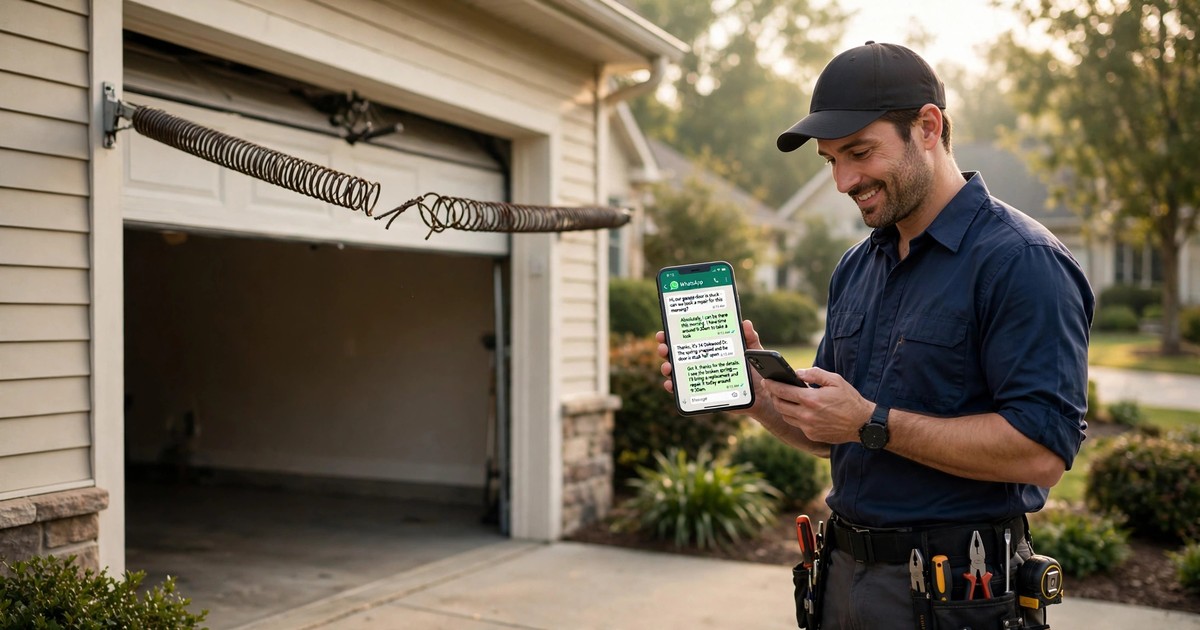
It is 7:05 in the morning. A homeowner stands in the garage in socks, car keys in hand, staring at a door that will not move. The car is inside. Work starts at eight. The torsion spring has snapped, but the homeowner does not know what a torsion spring is. All they know: the door is stuck and they are trapped.
They do not call you. They open WhatsApp and message your business.
That message is the most valuable moment in your business: an emergency buyer with zero patience and an open wallet, hiring the first company that answers with a clear plan. If your answer arrives three hours later — after the install, after you checked your phone — they have already hired someone else.
WhatsApp automation is how the first company to answer is always you, even when your hands are covered in grease.
Quick answer: WhatsApp automation for garage door companies answers every customer message in seconds, day or night. It sorts emergencies with two quick questions, collects photos of broken springs or cables for faster quotes, books same-day visits, sends technician ETAs, and asks for reviews after the job. It replaces missed calls — not your technicians.
What WhatsApp automation actually is for a garage door company
Think of it as the office assistant who never sleeps. A customer messages your business on WhatsApp, and the assistant replies instantly with a real conversation — not a dead "we will get back to you." It figures out what is wrong, collects the details, and books the visit. You step in only for human decisions.
It runs on the official WhatsApp Business Platform — the approved way for software to send and receive WhatsApp messages. That keeps your number safe and unlocks what the free app cannot do: real back-and-forth conversations, approved templates, and booking links.
Here is what it does for a garage door business:
- Answers every message in seconds, 24 hours a day.
- Asks the two or three questions that reveal what is actually broken.
- Collects photos and videos of the door, spring, cable, or opener.
- Books same-day or next-day visits straight into your calendar.
- Sends your technician's ETA and "on the way" updates.
- Follows up after the job to ask for a review.
- Sends tune-up and seasonal reminders that bring back old customers.
The automation handles the conversation; your technicians handle the door. That split is the whole point.
The 7 AM emergency: turning panic into a booked job
Garage door emergencies follow a pattern that favours whoever answers first. The door fails at the worst moment — before work, after dinner, on a holiday weekend — and every minute of silence pushes the customer toward the next company in the results.
The catch: "my door is stuck" can mean very different jobs. A snapped torsion spring is a same-day emergency. A door off its track needs eyes on it before quoting. A humming opener could be a stripped gear — or a locked handle the customer forgot. A dead remote might need a battery, not a new opener.
Your automation sorts this with two questions. Here is how the conversation flows:
Customer: My garage door won't open and I'm stuck. — Automation: Sorry you're dealing with this. First: does the door lift even a few inches by hand, or is it completely dead? — Customer: It won't budge at all. — Automation: Second: do you see a gap in the big coil spring above the door, or a cable hanging loose? — Customer: Yes, there's a gap in the spring. — Automation: That's a broken torsion spring — fixable today. I can get a technician to you this morning: 9–11 or 11–1?
Two questions turn panic into a booked slot in under a minute. When it is something simple — a locked handle, a tripped sensor — the automation says so first, saving you a wasted trip.
This is where most garage door companies bleed money: the emergency message arrives while you are on a job, and you see it at lunch — by which time the customer has hired whoever answered first. In this trade, speed is the entire sale.
Quote by photo: the fastest estimate you will ever give
Ask any garage door owner what slows down quoting: the customer cannot describe the problem. "The thing on top is broken" could be a torsion spring, a cable drum, or a center bearing plate. Over the phone you play twenty questions; on site you see it in five seconds.
Photo quoting closes that gap. The customer sends a picture through WhatsApp, and you are looking at the job instead of guessing. The automation asks for the shots that matter — spring area, both sides of the door, a short video of the door trying to move — then drops everything into one tidy thread: photo, answers, address, preferred time. Between jobs you reply in one message instead of five.
A broken torsion spring photographed clearly is quotable on the spot. A cable off the drum, shot from two angles, tells you whether it is a quick rewind or a full replacement. A blinking opener light? Ask the customer to count the blinks.
Two rules keep photo quoting honest. First, the automation never invents a price — it gives ranges you wrote, and anything unusual gets "a technician needs to see this in person." Made-up numbers destroy trust faster than slow replies. Second, every accepted quote becomes a booked visit in the same chat.
If turning chats into booked jobs is where your business leaks most, our lead capture automation guide covers the full capture-to-booking pipeline.
Same-day bookings and live technician ETAs
Once the problem is understood, the next question is always "when can someone come?" — and this is where companies lose jobs to a simple cause: the customer is ready to book, but booking takes too long.
The automation shows your real availability — this morning, this afternoon, tomorrow — and the customer taps a slot. The booking lands in your calendar with the name, address, problem summary, and photos, so your technician knows the whole story before knocking.
Then it keeps them informed: "Your technician is on the way — arrival between 2:00 and 2:30." "Running 15 minutes late — sorry." A customer waiting for a stranger is nervous; two short updates make them feel looked after, and looked-after customers leave five-star reviews.
Before launch, prepare five things: your service list, price ranges, after-hours policy, daily booking slots, and review-page link. That is the whole checklist.
Want this answering your customers? ReplyPilot, our own done-for-you service, builds a custom WhatsApp automation for your garage door company — instant answers, emergency triage, quote-by-photo, same-day bookings, ETAs, and review follow-ups — set up and run for you. Book your free demo.
After-hours capture: the shift that never sleeps
Garage doors break on their own schedule, and it ignores your office hours. The spring snaps at 10 PM. The opener dies on a Sunday morning. In this trade, messages arrive fastest exactly when nobody is there to answer.
An unanswered after-hours message is not a delayed reply — it is a lost job. Nobody with a stuck car waits until morning out of loyalty. They message the next company, and at midnight, almost nobody answers.
Want this for your garage door companies?
ReplyPilot builds a custom whatsapp automation setup for your garage door companies — answering customer questions instantly, taking orders and bookings, and handing off to you when a human is needed.
Ask on WhatsApp — it's freeYour automation is the night shift you never had to hire. At 11 PM it greets the customer, runs the same two-question triage, collects photos, and books the first morning slot — or sends your on-call phone a full summary so you decide in one glance whether to roll the truck.
You set the rules. True emergencies — car trapped inside, door hanging off its track — reach your phone. Everything else waits until morning, already triaged, photographed, and booked. You sleep. The business keeps working.
Reviews after the install: turning high-ticket jobs into five stars
A garage door job is not a coffee. A spring replacement, an opener install, a full door replacement — customers remember how the whole experience felt. That memory is gold if you ask at the right moment.
The right moment is the evening after the job, when the door glides up quietly for the first time. The automation sends a short message: the job is done, here is what was replaced — and if they are happy, would they tap the link and leave a review? No begging, no awkward ask from the technician.
Why does this matter more in your trade? Your next customer is choosing between three companies with nearly identical websites, and the one with the most recent five-star reviews wins. Every automated request that becomes a review is a small ad that runs forever, for free.
The automation also catches the unhappy customer before they reach Google. If something is not right — the door is still noisy, the remote range is short — the message goes straight to you, not to a public review page. You fix it while it is still private. That one routing rule has saved more reputations than any campaign.
Tune-ups and seasonal reminders: the quiet repeat business
Every garage door you have ever touched is a future job. A spring replacement from three years ago means rollers due for a check — and the customer will not remember. Your automation does.
Once a year, past customers get a friendly message: it has been a while since their last service, and a tune-up keeps the door quiet and catches worn parts before they snap — with a one-tap booking link.
Time them to the season: before winter, doors get stiff and openers work harder in the cold, so the reminder reads as care, not spam. One or two useful messages a year is welcome; weekly promotions are not.
What WhatsApp automation does NOT do
The automation cannot diagnose a door it has not seen. Photos help, but some problems need a technician in the garage — a door out of square, a fault that only happens when it rains. The automation collects the evidence and books the visit; the diagnosis belongs to the person with the tools.
It cannot do your marketing. If nobody messages you, the finest automation sits idle. It turns conversations into jobs; it does not create them. Advertising and your reviews do that job.
It will not make judgment calls about money. Discounts and warranty exceptions need a human. Every setup needs escalation rules: price disputes, safety concerns, and unhappy customers go straight to your phone.
And it cannot replace the relationship. The technician who explains what broke and shows the worn part is why that customer calls you again in five years. Automation wins the first conversation; people win the customer.
The WhatsApp rules that actually get numbers banned
WhatsApp bans numbers that misbehave, and the rules fit on a sticky note. One: only send marketing to people who clearly agreed. Blasting a tune-up offer to an old list gets you mass-blocked, which tanks your quality rating. Two: if a customer has not messaged in 24 hours, you may only restart with a pre-approved template. Three: watch your quality rating like a fuel gauge — green means carry on, yellow means stop marketing and fix your list.
None of this is scary for an honest business. Confirmations, ETA updates, and replies are welcome messages — customers want them. The banned numbers treated WhatsApp like a spam cannon. When in doubt: did this customer ask to hear from me?
The official WhatsApp Business Platform documentation is the final word on the rules. For the practical setup — approval, connecting a number, first templates — our WhatsApp Business API setup guide walks through every step.
Mistakes that kill garage door automations
Bad automation is worse than no automation. A bot that frustrates a customer with a stuck car loses the job, the review, and the referral. Here are the failures to avoid, with the root cause of each.
Building a FAQ page instead of a triage system. The bot answers "what are your hours?" beautifully but cannot tell a broken spring from a dead remote. Root cause: the owner automated the easy questions, not the emergency. Fix: triage first.
Letting the bot invent prices. A customer asks what a spring replacement costs and the bot names a figure nobody approved. Root cause: the bot got freedom instead of boundaries. Fix: it only quotes ranges you wrote. Anything unusual gets "a technician needs to see this."
No human escape route at night. A stuck or unsafe door at midnight gets a cheerful "we open at 8 AM." Root cause: the owner feared night calls more than lost jobs. Fix: true emergencies ping your on-call phone with a full summary.
Setting it and forgetting it. Prices changed — and the bot still promises last year's version. Root cause: nobody owned the system after launch. Fix: thirty minutes a month to check prices, hours, and services.
Blasting promotions to cold lists. Reminders go to every number ever collected, including people who never agreed. Root cause: treating WhatsApp like email. Fix: reminders only to past customers who opted in.
DIY vs hiring vs buying vs done-for-you: the honest comparison
Four ways to solve the same problem. None is right for everyone.
Answer everything yourself. Cost: nothing but your evenings — until message volume grows or emergencies pile up mid-install. Every garage door company starts here; almost none can stay past the first growth spurt.
Hire someone to answer messages. Cost: a monthly wage for part-time help. They reply well during office hours and go home at five — exactly when emergencies arrive. Fine for a big shop; a poor fit for a two-truck company.
Build it yourself with tools like n8n. Cost: nearly free in software, expensive in time and skill — and when a flow breaks at 11 PM on a Saturday, you are the support team. Our n8n WhatsApp automation tutorial shows a full build.
Buy a tool and set it up yourself. Cost: a monthly subscription plus per-message fees — typically well under a part-time hire. You get the night shift, triage, and booking flow, but you spend your own evenings building flows and writing templates.
Hire it done-for-you. Cost: more than DIY software, less than an employee. Someone builds the triage flows, connects your calendar, gets templates approved, and monitors the system. You get the bookings. Full disclosure: this is the ReplyPilot model, and ReplyPilot is our own service.
Match the option to your time, skill, and patience. A technical owner with spare evenings should build; an owner who wants the result without the homework should hire it done. If your customers mostly call rather than message, read our AI phone receptionist guide first.
Frequently asked questions
Can WhatsApp automation really tell a broken spring from a dead opener remote?
Surprisingly close, with two or three questions. A gap in the coil spring, a cable hanging loose, a door that will not budge — each answer points to a different job. Anything ambiguous gets booked as an inspection, not a guess.
Will customers be annoyed talking to a bot during an emergency?
Customers are annoyed by silence, not by speed. In an emergency they want an instant answer and a clear plan: what is wrong, when someone is coming, what it costs. A bot that answers in under a minute beats a human who calls back three hours later. When judgment is needed — a price dispute, a safety worry — the conversation goes straight to you.
How does it give prices without making numbers up?
It invents nothing. You write the price ranges, and the automation only repeats your words. Anything outside those ranges gets "a technician needs to see the door in person." That boundary is built into the system.
What happens when a customer sends a photo of the damage?
The automation asks for the photos that help — the spring area, both sides of the door, a short video of the door trying to move. Everything lands in one thread with the customer's answers, address, and preferred time, so you reply in one message between jobs.
Is this only for big companies, or does it work for a one-truck operation?
It fits a one-truck operation best. A big company has a dispatcher; a solo owner has a ladder, a van, and a phone that rings while both hands are busy. The automation is the dispatcher you cannot afford yet: it answers while you work, books while you drive, and follows up while you sleep.
A garage door emergency is a customer with no patience and an open wallet. In your town, those customers are messaging three companies at once and hiring the one that answers first. WhatsApp automation makes sure that company is you — at 7 AM, at midnight, and every hour in between.
One clear next step: write down the five messages you receive most, and notice how many arrive while you cannot answer. If the answer is "most of them," you have an answering problem — the easiest problem in this article to fix.
ReplyPilot is our own done-for-you WhatsApp automation service. This article was written by the ReplyPilot team in October 2026.